অধ্যায়-১ : সেট ও ফাংশন উচ্চতর গণিত

SSC উচ্চতর গণিত এর অধ্যায়-১ : সেট ও ফাংশন অধ্যায়ের বোর্ড প্রশ্ন ও MCQ অনুশীলন করো।

৩২৩

প্রশ্ন

উচ্চতর গণিত

বিষয়

SSC

ক্লাস

সাম্প্রতিক প্রশ্ন

SSCউচ্চতর গণিতসৃজনশীল

উদ্দীপক

f(x)=x−2x−3f(\mathrm{x})=\frac{\mathrm{x}-2}{\mathrm{x}-3} এবং g(x)=3xg(\mathrm{x})=3^{\mathrm{x}}. [ময়মনসিংহ জিলা স্কুল]
ক
ডোমেন ff নির্ণয় করো।

উত্তর

এখানে, f(x)=x−2x−3f(\mathrm{x})=\frac{\mathrm{x}-2}{\mathrm{x}-3} f(x)=x−2x−3∈Rf(\mathrm{x})=\frac{\mathrm{x}-2}{\mathrm{x}-3} \in \mathbb{R} হবে যদি ও কেবল যদি, x−3≠0\mathrm{x}-3 \neq 0 বা, x≠3\mathrm{x} \neq 3 হয় ∴\therefore ডোমেন f(x)={x:x∈Rf(\mathrm{x})=\{\mathrm{x}: \mathrm{x} \in \mathbb{R} এবং x≠3}=R−{3}\mathrm{x} \neq 3\}=\mathbb{R}-\{3\}।
খ
g−1(x)g^{-1}(\mathrm{x}) এবং রেঞ্জ gg নির্ণয় করো।

উত্তর

দেওয়া আছে, g(x)=3xg(\mathrm{x})=3^{\mathrm{x}} ধরি, y=g(x)=3x\mathrm{y}=g(\mathrm{x})=3^{\mathrm{x}} বা, log⁡3y=log⁡33x=xlog⁡33=x×1\log_3 \mathrm{y}=\log_3 3^{\mathrm{x}}=\mathrm{x} \log_3 3=\mathrm{x} \times 1 বা, x=log⁡3y\mathrm{x}=\log_3 \mathrm{y} বা, g−1(y)=log⁡3yg^{-1}(\mathrm{y})=\log_3 \mathrm{y} [∵y=g(x)\because \mathrm{y}=g(\mathrm{x}) বা, g−1(y)=g−1{g(x)}g^{-1}(\mathrm{y})=g^{-1}\{g(\mathrm{x})\} ∴g−1(y)=x\therefore g^{-1}(\mathrm{y})=\mathrm{x}] ∴g−1(x)=log⁡3x\therefore g^{-1}(\mathrm{x})=\log_3 \mathrm{x} এখন g−1(x)g^{-1}(\mathrm{x}) সংজ্ঞায়িত হবে যদি এবং কেবল যদি x>0\mathrm{x}>0 হয়। ∴\therefore রেঞ্জ, g(x)={x:R:x>0}g(\mathrm{x})=\{\mathrm{x}: \mathbb{R}: \mathrm{x}>0\} নির্ণেয় g−1(x)=log⁡3xg^{-1}(\mathrm{x})=\log_3 \mathrm{x} এবং রেঞ্জ g(x)={x∈R:x>0}g(\mathrm{x})=\{\mathrm{x} \in \mathbb{R}: \mathrm{x}>0\}
গ
f(x)f(\mathrm{x}) ফাংশন এক-এক এবং সার্বিক কি-না যাচাই করো।

উত্তর

দেওয়া আছে, f(x)=x−2x−3f(\mathrm{x})=\frac{\mathrm{x}-2}{\mathrm{x}-3} f(x)∈Rf(\mathrm{x}) \in \mathbb{R} হবে যদি ও কেবল যদি x−3≠0\mathrm{x}-3 \neq 0 বা, x≠3\mathrm{x} \neq 3 হয়। ∴f(x)\therefore f(\mathrm{x}) এর ডোমেন =R−{3}=\mathbb{R}-\{3\} ধরি, a,b∈\mathrm{a}, \mathrm{b} \in ডোম ff ∴f(a)=a−2a−3\therefore f(\mathrm{a})=\frac{\mathrm{a}-2}{\mathrm{a}-3} এবং f(b)=b−2b−3f(\mathrm{b})=\frac{\mathrm{b}-2}{\mathrm{b}-3} f(x)f(\mathrm{x}) এক-এক ফাংশন হবে যদি ও কেবল যদি যেকোনো a,b∈\mathrm{a}, \mathrm{b} \in ডোম ff এর জন্য f(a)=f(b)f(\mathrm{a})=f(\mathrm{b}) হলে a=b\mathrm{a}=\mathrm{b} হয়। ধরি, f(a)=f(b)f(\mathrm{a})=f(\mathrm{b}) বা, a−2a−3=b−2b−3\frac{\mathrm{a}-2}{\mathrm{a}-3}=\frac{\mathrm{b}-2}{\mathrm{b}-3} বা, (a−3)(b−2)=(a−2)(b−3)(\mathrm{a}-3)(\mathrm{b}-2)=(\mathrm{a}-2)(\mathrm{b}-3) বা, ab−2a−3b+6=ab−3a−2b+6\mathrm{ab}-2 \mathrm{a}-3 \mathrm{b}+6=\mathrm{ab}-3 \mathrm{a}-2 \mathrm{b}+6 বা, −2a+3a=−2b+3b-2 \mathrm{a}+3 \mathrm{a}=-2 \mathrm{b}+3 \mathrm{b} ∴a=b\therefore \mathrm{a}=\mathrm{b} সুতরাং, f(x)f(\mathrm{x}) একটি এক-এক ফাংশন। আবার, ধরি, y=f(x)=x−2x−3\mathrm{y}=f(\mathrm{x})=\frac{\mathrm{x}-2}{\mathrm{x}-3} তাহলে, y=x−2x−3\mathrm{y}=\frac{\mathrm{x}-2}{\mathrm{x}-3} বা, xy−3y=x−2\mathrm{xy}-3 \mathrm{y}=\mathrm{x}-2 বা, xy−x=3y−2\mathrm{xy}-\mathrm{x}=3 \mathrm{y}-2 বা, x(y−1)=3y−2\mathrm{x}(\mathrm{y}-1)=3 \mathrm{y}-2 বা, x=3y−2y−1\mathrm{x}=\frac{3 \mathrm{y}-2}{\mathrm{y}-1} ∴x=3y−2y−1∈R\therefore \mathrm{x}=\frac{3 \mathrm{y}-2}{\mathrm{y}-1} \in \mathbb{R} হবে যদি ও কেবল যদি y−1≠0\mathrm{y}-1 \neq 0 বা, y≠1\mathrm{y} \neq 1 হয়। ∴f(x)\therefore f(\mathrm{x}) এর রেঞ্জ =R−{1}==\mathbb{R}-\{1\}= কোডোমেন ∴f(x)\therefore f(\mathrm{x}) একটি সার্বিক ফাংশন। সুতরাং, f(x)f(\mathrm{x}) ফাংশন এক-এক এবং সার্বিক। [লক্ষ করো: f:R−{3}→R−{1}f: \mathbb{R}-\{3\} \to \mathbb{R}-\{1\} শর্তে ফাংশনটি সংজ্ঞায়িত, এক-এক এবং সার্বিক ফাংশন]

সম্পূর্ণ প্রশ্ন দেখো
SSCউচ্চতর গণিতসৃজনশীল

উদ্দীপক

U={x:x\mathrm{U}=\{\mathrm{x}: \mathrm{x} ধনাত্মক পূর্ণসংখ্যা}\}, A={x:x≥5}⊂U\mathrm{A}=\{\mathrm{x}: \mathrm{x} \geq 5\} \subset \mathrm{U} B={x:5x<12}⊂U.C=A′∪B\mathrm{B}=\{\mathrm{x}: 5 \mathrm{x}<12\} \subset \mathrm{U}. \mathrm{C}=\mathrm{A}^{\prime} \cup \mathrm{B} এবং S={3n,n=0\mathrm{S}=\{3^{\mathrm{n}}, \mathrm{n}=0 অথবা, n∈N}\mathrm{n} \in \mathbb{N}\}. [বগুড়া সরকারি বালিকা উচ্চ বিদ্যালয়]
ক
A′\mathrm{A}^{\prime} নির্ণয় করো।

উত্তর

দেওয়া আছে, U={x:x\mathrm{U}=\{\mathrm{x}: \mathrm{x} ধনাত্মক পূর্ণসংখ্যা}={1,2,3,4,5,6,7,8,9,10,11,…}\}=\{1,2,3,4,5,6,7,8,9,10,11, \ldots\} A={x:x≥5}⊂U\mathrm{A}=\{\mathrm{x}: \mathrm{x} \geq 5\} \subset \mathrm{U} এখন, A\mathrm{A} সেট তালিকা আকারে প্রকাশ করে পাই, A={5,6,7,8,…}\mathrm{A}=\{5,6,7,8, \ldots\} ∴A′=U−A\therefore \mathrm{A}^{\prime}=\mathrm{U}-\mathrm{A} ={1,2,3,4,5,6,7,8,9,10,…}−{5,6,7,8,…}\qquad=\{1,2,3,4,5,6,7,8,9,10, \ldots\}-\{5,6,7,8, \ldots\} ={1,2,3,4}\qquad=\{1,2,3,4\}
খ
প্রমাণ করো যে, P(B∩C)=P(B)∩P(C)\mathrm{P}(\mathrm{B} \cap \mathrm{C})=\mathrm{P}(\mathrm{B}) \cap \mathrm{P}(\mathrm{C}).

উত্তর

ক-হতে পাই, U={1,2,3,4,5,6,7,8,9,10,11,…}\mathrm{U}=\{1,2,3,4,5,6,7,8,9,10,11, \ldots\} এবং A′={1,2,3,4}\mathrm{A}^{\prime}=\{1,2,3,4\} B={x:5x<12}⊂U\mathrm{B}=\{\mathrm{x}: 5 \mathrm{x}<12\} \subset \mathrm{U} B\mathrm{B} কে তালিকা আকারে প্রকাশ করে পাই, B={1,2}\mathrm{B}=\{1,2\} C=A′∪B\mathrm{C}=\mathrm{A}^{\prime} \cup \mathrm{B} ={1,2,3,4}∪{1,2}={1,2,3,4}=\{1,2,3,4\} \cup\{1,2\}=\{1,2,3,4\} এখন, B∩C={1,2}∩{1,2,3,4}={1,2}\mathrm{B} \cap \mathrm{C}=\{1,2\} \cap\{1,2,3,4\}=\{1,2\} ∴P(B∩C)={{1},{2},{1,2},∅}\therefore \mathrm{P}(\mathrm{B} \cap \mathrm{C})=\{\{1\},\{2\},\{1,2\}, \emptyset\} আবার, P(B)={{1},{2},{1,2},∅}\mathbf{P ( B )}=\{\{1\},\{2\},\{1,2\}, \varnothing\} এবং P(C) = {{1}, {2}, {3}, {4}, {1, 2}, {1,3}, {1,4}, {2, 3}, {2, 4}, {3, 4}, {1, 2, 3}, {1, 2, 4}, {1, 3, 4}, {2, 3, 4}, {1, 2, 3, 4}, ∅} ∴ P(B) P(C) = {{1}, {2}, {1, 2},∅ }∩ {{1}, {2}, {3}, {4}, {1, 2}, {1,3}, {1,4}, {2, 3}, {2, 4}, {3, 4}, {1, 2, 3}, {1, 2, 4}, {1, 3, 4}, {2, 3, 4}, {1, 2, 3, 4}, ∅} ={{1},{2},{1,2},∅}=\{\{1\},\{2\},\{1,2\}, \varnothing\} ∴P(B∩C)=P(B)∩P(C)\therefore \mathrm{P}(\mathrm{B} \cap \mathrm{C})=\mathrm{P}(\mathrm{B}) \cap \mathrm{P}(\mathrm{C}) (প্রমাণিত)
গ
S\mathrm{S} সেটের এমন একটি প্রকৃত উপসেট S1\mathrm{S}_1 বর্ণনা করো। যা S\mathrm{S} এর সমতুল্য এবং S\mathrm{S} এর সাথে S1\mathrm{S}_1 এর এক-এক মিলটি বর্ণনা করো।

উত্তর

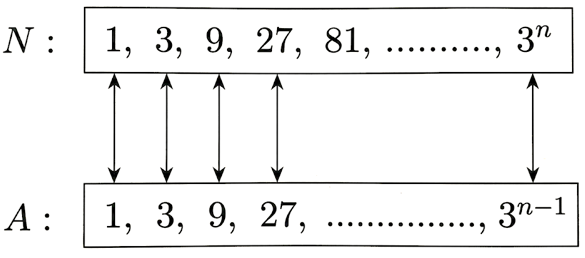
দেওয়া আছে, S={3n,n=0\mathrm{S}=\{3^{\mathrm{n}}, \mathrm{n}=0 অথবা n∈N}\mathrm{n} \in \mathbb{N}\} এখন, n=0\mathrm{n}=0 হলে, S=30=1\mathrm{S}=3^0=1 n∈N\mathrm{n} \in \mathbb{N} এর জন্য n=1\mathrm{n}=1 হলে, S=31=3\mathrm{S}=3^1=3 n=2\mathrm{n}=2 হলে, S=32=9\mathrm{S}=3^2=9 n=3\mathrm{n}=3 হলে, S=33=27\mathrm{S}=3^3=27 n=4\mathrm{n}=4 হলে, S=34=81\mathrm{S}=3^4=81 …………\ldots\ldots\ldots\ldots …………\ldots\ldots\ldots\ldots ∴S={1,3,9,27,81,…,3n}\therefore \mathrm{S}=\{1,3,9,27,81, \ldots, 3^{\mathrm{n}}\} ∴\therefore প্রকৃত উপসেট, S1={1,3,9,27,81,…}\mathrm{S}_1=\{1,3,9,27,81, \ldots\} ={30,31,32,33,…,3n−1,n=0\qquad=\{3^0, 3^1, 3^2, 3^3, \ldots, 3^{\mathrm{n}-1}, \mathrm{n}=0; যেখানে n∈N}\mathrm{n} \in \mathbb{N}\} ∴S1\therefore \mathrm{S}_1 হলো S\mathrm{S} সেটের প্রকৃত উপসেট, যা S\mathrm{S} সেটের সমতুল্য (S1⊂S\mathrm{S}_1 \subset \mathrm{S}) ∴S\therefore \mathrm{S} ও S1\mathrm{S}_1 সেট দুইটির মধ্যে এক-এক মিল নিচের চিত্রে দেখানো হলো : question image সুতরাং S\mathrm{S} ও S1\mathrm{S}_1 সেট দুইটি সমতুল।

সম্পূর্ণ প্রশ্ন দেখো

SSCউচ্চতর গণিতসৃজনশীল

উদ্দীপক

A,B\mathrm{A}, \mathrm{B} সান্ত সেট এবং A,B,N⊆U\mathrm{A}, \mathrm{B}, \mathbb{N} \subseteq \mathrm{U} এবং f:R−{12}→R−{12}f: \mathbb{R}-\left\{\frac{1}{2}\right\} \to \mathbb{R}-\left\{\frac{1}{2}\right\}; যেন f(x)=x+42x−1f(\mathrm{x})=\frac{\mathrm{x}+4}{2 \mathrm{x}-1}. [আইডিয়াল স্কুল এন্ড কলেজ, মতিঝিল ঢাকা]
ক
প্রমাণ করো যে, স্বাভাবিক সংখ্যার সেট N\mathbb{N} একটি অনন্ত সেট।

উত্তর

আমরা জানি, স্বাভাবিক সংখ্যার সেট, N={1,2,3,4,5,6,…,n}\mathbb{N}=\{1,2,3,4,5,6, \ldots, \mathrm{n}\} N\mathbb{N} সেট থেকে বিজোড় স্বাভাবিক সংখ্যাসমূহ নিয়ে গঠিত সেট, A={1,3,5,7,…}\mathrm{A}=\{1,3,5,7, \ldots\} জোড় স্বাভাবিক সংখ্যাসমূহ নিয়ে গঠিত সেট, B={2,4,6,8,…}\mathrm{B}=\{2,4,6,8, \ldots\} 33-এর গুণিতকসমূহ নিয়ে গঠিত সেট, C={3,6,9,…}\mathrm{C}=\{3,6,9, \ldots\} এখানে, N\mathbb{N} সেট থেকে গঠিত A,B\mathrm{A}, \mathrm{B} ও C\mathrm{C} সেটসমূহ থেকে উপাদান সংখ্যা গণনা করে নির্ধারণ করা যায় না। তাই, A,B\mathrm{A}, \mathrm{B} ও C\mathrm{C} অনন্ত সেট। সুতরাং, স্বাভাবিক সংখ্যার সেট N\mathbb{N} একটি অনন্ত সেট।
খ
প্রমাণ করো যে, n(A∪B)=n(A)+n(B)−n(A∩B)\mathrm{n}(\mathrm{A} \cup \mathrm{B})=\mathrm{n}(\mathrm{A})+\mathrm{n}(\mathrm{B})-\mathrm{n}(\mathrm{A} \cap \mathrm{B}).

উত্তর

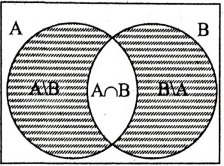
এখানে, A∖B,A∩B\mathrm{A} \setminus \mathrm{B}, \mathrm{A} \cap \mathrm{B} এবং B∖A\mathrm{B} \setminus \mathrm{A} সেট তিনটি পরস্পর নিচ্ছেদ সেট এবং A=(A∖B)∪(A∩B)\mathrm{A}=(\mathrm{A} \setminus \mathrm{B}) \cup(\mathrm{A} \cap \mathrm{B}) B=(B∖A)∪(A∩B)\mathrm{B}=(\mathrm{B} \setminus \mathrm{A}) \cup(\mathrm{A} \cap \mathrm{B}) A∪B=(A∖B)∪(A∩B)∪(B∖A)\mathrm{A} \cup \mathrm{B}=(\mathrm{A} \setminus \mathrm{B}) \cup(\mathrm{A} \cap \mathrm{B}) \cup(\mathrm{B} \setminus \mathrm{A}) question image ∴n(A)=n(A∖B)+n(A∩B)\therefore \mathrm{n}(\mathrm{A})=\mathrm{n}(\mathrm{A} \setminus \mathrm{B})+\mathrm{n}(\mathrm{A} \cap \mathrm{B}) …….(1)\ldots\ldots. (1) n(B)=n(B∖A)+n(A∩B)\mathrm{n}(\mathrm{B})=\mathrm{n}(\mathrm{B} \setminus \mathrm{A})+\mathrm{n}(\mathrm{A} \cap \mathrm{B}) …….(2)\ldots\ldots. (2) n(A∪B)=n(A∖B)+n(A∩B)+n(B∖A)\mathrm{n}(\mathrm{A} \cup \mathrm{B})=\mathrm{n}(\mathrm{A} \setminus \mathrm{B})+\mathrm{n}(\mathrm{A} \cap \mathrm{B})+\mathrm{n}(\mathrm{B} \setminus \mathrm{A}) …….(3)\ldots\ldots. (3) সুতরাং (1) নং থেকে পাই, n(A∖B)=n(A)−n(A∩B)\mathrm{n}(\mathrm{A} \setminus \mathrm{B})=\mathrm{n}(\mathrm{A})-\mathrm{n}(\mathrm{A} \cap \mathrm{B}) (2) নং থেকে পাই, n(B∖A)=n(B)−n(A∩B)\mathrm{n}(\mathrm{B} \setminus \mathrm{A})=\mathrm{n}(\mathrm{B})-\mathrm{n}(\mathrm{A} \cap \mathrm{B}) এখন, n(A∖B)\mathrm{n}(\mathrm{A} \setminus \mathrm{B}) এবং n(B∖A)\mathrm{n}(\mathrm{B} \setminus \mathrm{A}) এর মান (3) নং এ বসিয়ে পাই, n(A∪B)=n(A)−n(A∩B)+n(A∩B)+n(B)−n(A∩B)\mathrm{n}(\mathrm{A} \cup \mathrm{B})=\mathrm{n}(\mathrm{A})-\mathrm{n}(\mathrm{A} \cap \mathrm{B})+\mathrm{n}(\mathrm{A} \cap \mathrm{B})+\mathrm{n}(\mathrm{B})-\mathrm{n}(\mathrm{A} \cap \mathrm{B}) ∴n(A∪B)=n(A)+n(B)−n(A∩B)\therefore \mathrm{n}(\mathrm{A} \cup \mathrm{B})=\mathrm{n}(\mathrm{A})+\mathrm{n}(\mathrm{B})-\mathrm{n}(\mathrm{A} \cap \mathrm{B})। (প্রমাণিত)
গ
f(x)f(\mathrm{x}) এক-এক এবং সার্বিক কি-না যাচাই করো।

উত্তর

দেওয়া আছে, f(x)=x+42x−1f(\mathrm{x})=\frac{\mathrm{x}+4}{2 \mathrm{x}-1} f(x)∈Rf(\mathrm{x}) \in \mathbb{R} হবে যদি ও কেবল যদি 2x−1≠02 \mathrm{x}-1 \neq 0 বা, x≠12\mathrm{x} \neq \frac{1}{2} হয়। ∴f(x)\therefore f(\mathrm{x}) এর ডোমেন =R−{12}=\mathbb{R}-\left\{\frac{1}{2}\right\} ধরি, a,b∈\mathrm{a}, \mathrm{b} \in ডোম f(x)f(\mathrm{x}) ∴f(a)=a+42a−1\therefore f(\mathrm{a})=\frac{\mathrm{a}+4}{2 \mathrm{a}-1} এবং f(b)=b+42b−1f(\mathrm{b})=\frac{\mathrm{b}+4}{2 \mathrm{b}-1} এখন, f(x)f(\mathrm{x}) এক-এক ফাংশন হবে যদি ও কেবল যদি f(a)=f(b)f(\mathrm{a})=f(\mathrm{b}) এর জন্য a=b\mathrm{a}=\mathrm{b} হয়। f(a)=f(b)f(\mathrm{a})=f(\mathrm{b}) হলে, a+42a−1=b+42b−1\frac{\mathrm{a}+4}{2 \mathrm{a}-1}=\frac{\mathrm{b}+4}{2 \mathrm{b}-1} বা, 2ab−a+8b−4=2ab−b+8a−42 \mathrm{ab}-\mathrm{a}+8 \mathrm{b}-4=2 \mathrm{ab}-\mathrm{b}+8 \mathrm{a}-4 বা, 8b+b=8a+a8 \mathrm{b}+\mathrm{b}=8 \mathrm{a}+\mathrm{a} বা, 9a=9b9 \mathrm{a}=9 \mathrm{b} ∴a=b\therefore \mathrm{a}=\mathrm{b} ∴f(x)\therefore f(\mathrm{x}) একটি এক-এক ফাংশন। আবার ধরি, y=f(x)=x+42x−1\mathrm{y}=f(\mathrm{x})=\frac{\mathrm{x}+4}{2 \mathrm{x}-1} ∴y=f(x)\therefore \mathrm{y}=f(\mathrm{x}) বা, x=f−1(y)\mathrm{x}=f^{-1}(\mathrm{y}) আবার, y=x+42x−1\mathrm{y}=\frac{\mathrm{x}+4}{2 \mathrm{x}-1} বা, 2xy−y=x+42 \mathrm{xy}-\mathrm{y}=\mathrm{x}+4 বা, 2xy−x=y+42 \mathrm{xy}-\mathrm{x}=\mathrm{y}+4 বা, x(2y−1)=y+4\mathrm{x}(2 \mathrm{y}-1)=\mathrm{y}+4 বা, x=y+42y−1\mathrm{x}=\frac{\mathrm{y}+4}{2 \mathrm{y}-1} ∴f−1(y)=y+42y−1\therefore f^{-1}(\mathrm{y})=\frac{\mathrm{y}+4}{2 \mathrm{y}-1} এখন, f−1(y)∈Rf^{-1}(\mathrm{y}) \in \mathbb{R} হবে যদি ও কেবল যদি 2y−1≠02 \mathrm{y}-1 \neq 0 বা, y≠12\mathrm{y} \neq \frac{1}{2} হয়। ∴f(x)\therefore f(\mathrm{x}) এর রেঞ্জ =f−1(x)=f^{-1}(\mathrm{x}) এর ডোমেন =R−{12}==\mathbb{R}-\left\{\frac{1}{2}\right\}= কোডোমেন ∴f(x)\therefore f(\mathrm{x}) একটি সার্বিক ফাংশন। অতএব, f(x)f(\mathrm{x}) এক-এক এবং সার্বিক।

সম্পূর্ণ প্রশ্ন দেখো

SSCউচ্চতর গণিতসৃজনশীল

উদ্দীপক

A={x:x∈R\mathrm{A}=\{\mathrm{x}: \mathrm{x} \in \mathbb{R} এবং x2−(a+b)x+ab=0}\mathrm{x}^2-(\mathrm{a}+\mathrm{b}) \mathrm{x}+\mathrm{ab}=0\}, B={2,3},C={2,4,5}\mathrm{B}=\{2,3\}, \mathrm{C}=\{2,4,5\} যেখানে a,b∈R\mathrm{a}, \mathrm{b} \in \mathbb{R}. [ঢাকা বোর্ড ২০১৫]
ক
A\mathrm{A} সেটের উপাদানসমূহ নির্ণয় করো।

উত্তর

A={x:x∈R\mathrm{A}=\{\mathrm{x}: \mathrm{x} \in \mathbb{R} এবং x2−(a+b)x+ab=0}\mathrm{x}^2-(\mathrm{a}+\mathrm{b}) \mathrm{x}+\mathrm{ab}=0\} এখানে, x2−(a+b)x+ab=0\mathrm{x}^2-(\mathrm{a}+\mathrm{b}) \mathrm{x}+\mathrm{ab}=0 বা, x2−ax−bx+ab=0\mathrm{x}^2-\mathrm{ax}-\mathrm{bx}+\mathrm{ab}=0 বা, x(x−a)−b(x−a)=0\mathrm{x}(\mathrm{x}-\mathrm{a})-\mathrm{b}(\mathrm{x}-\mathrm{a})=0 বা, (x−a)(x−b)=0(\mathrm{x}-\mathrm{a})(\mathrm{x}-\mathrm{b})=0 হয়, x−a=0\mathrm{x}-\mathrm{a}=0 বা, x=a\mathrm{x}=\mathrm{a} ∴A={a,b}\therefore \mathrm{A}=\{\mathrm{a}, \mathrm{b}\} অথবা, x−b=0\mathrm{x}-\mathrm{b}=0 বা, x=b\mathrm{x}=\mathrm{b} অতএব, A\mathrm{A} সেটের উপাদানসমূহ হচ্ছে a,b\mathrm{a}, \mathrm{b}।
খ
দেখাও যে, P(B∩C)=P(B)∩P(C)\mathrm{P}(\mathrm{B} \cap \mathrm{C})=\mathrm{P}(\mathrm{B}) \cap \mathrm{P}(\mathrm{C}).

উত্তর

দেওয়া আছে, B={2,3}\mathrm{B}=\{2,3\} ও C={2,4,5}\mathrm{C}=\{2,4,5\} $
∴B∩C={2,3}∩{2,4,5}={2}\therefore \mathrm{B} \cap \mathrm{C}=\{2,3\} \cap\{2,4,5\} =\{2\}
$ ∴P(B∩C)={∅,{2}}\therefore \mathrm{P}(\mathrm{B} \cap \mathrm{C})=\{\emptyset,\{2\}\} P(B)={∅,{2},{3},{2,3}}\mathrm{P}(\mathrm{B})=\{\emptyset,\{2\},\{3\},\{2,3\}\} P(C)={∅,{2},{4},{5},{2,4},{2,5},{4,5},{2,4,5}}\mathrm{P}(\mathrm{C})=\{\emptyset,\{2\},\{4\},\{5\},\{2,4\},\{2,5\},\{4,5\},\{2,4,5\}\} ∴P(B)∩P(C)={∅,{2},{3},{2,3}}∩{∅,{2},{4},{5},{2,4},{2,5},{4,5},{2,4,5}}\therefore \mathrm{P}(\mathrm{B}) \cap \mathrm{P}(\mathrm{C})=\{\emptyset,\{2\},\{3\},\{2,3\}\} \cap \{\emptyset,\{2\},\{4\},\{5\},\{2,4\},\{2,5\},\{4,5\},\{2,4,5\}\} ={∅,{2}}\qquad=\{\emptyset,\{2\}\} ∴P(B∩C)=P(B)∩P(C)\therefore \mathrm{P}(\mathrm{B} \cap \mathrm{C})=\mathrm{P}(\mathrm{B}) \cap \mathrm{P}(\mathrm{C})। (দেখানো হলো)
গ
প্রমাণ করো যে, A×(B∪C)=(A×B)∪(A×C)\mathrm{A} \times(\mathrm{B} \cup \mathrm{C})=(\mathrm{A} \times \mathrm{B}) \cup(\mathrm{A} \times \mathrm{C}).

উত্তর

দেওয়া আছে, B={2,3}\mathrm{B}=\{2,3\} এবং C={2,4,5}\mathrm{C}=\{2,4,5\} ক-হতে প্রাপ্ত, A={a,b}\mathrm{A}=\{\mathrm{a}, \mathrm{b}\} $
B∪C={2,3}∪{2,4,5}={2,3,4,5}\mathrm{B} \cup \mathrm{C}=\{2,3\} \cup\{2,4,5\} =\{2,3,4,5\}
$ A×(B∪C)={a,b}×{2,3,4,5}\mathrm{A} \times(\mathrm{B} \cup \mathrm{C})=\{\mathrm{a}, \mathrm{b}\} \times\{2,3,4,5\} ={(a,2),(a,3),(a,4),(a,5),(b,2),(b,3),(b,4),(b,5)}\qquad=\{(\mathrm{a}, 2),(\mathrm{a}, 3),(\mathrm{a}, 4),(\mathrm{a}, 5),(\mathrm{b}, 2),(\mathrm{b}, 3),(\mathrm{b}, 4),(\mathrm{b}, 5)\} আবার, $
A×B={a,b}×{2,3}={(a,2),(a,3),(b,2),(b,3)}\mathrm{A} \times \mathrm{B}=\{\mathrm{a}, \mathrm{b}\} \times\{2,3\} =\{(\mathrm{a}, 2),(\mathrm{a}, 3),(\mathrm{b}, 2),(\mathrm{b}, 3)\}
$ A×C={a,b}×{2,4,5}={(a,2),(a,4),(a,5),(b,2),(b,4),(b,5)}\mathrm{A} \times \mathrm{C}=\{\mathrm{a}, \mathrm{b}\} \times\{2,4,5\}=\{(\mathrm{a}, 2),(\mathrm{a}, 4),(\mathrm{a}, 5),(\mathrm{b}, 2),(\mathrm{b}, 4),(\mathrm{b}, 5)\} (A×B)∪(A×C)={(a,2),(a,3),(b,2),(b,3)}∪{(a,2),(a,4),(a,5),(b,2),(b,4),(b,5)}(\mathrm{A} \times \mathrm{B}) \cup(\mathrm{A} \times \mathrm{C})=\{(\mathrm{a}, 2),(\mathrm{a}, 3),(\mathrm{b}, 2),(\mathrm{b}, 3)\} \cup\{(\mathrm{a}, 2),(\mathrm{a}, 4),(\mathrm{a}, 5),(\mathrm{b}, 2),(\mathrm{b}, 4),(\mathrm{b}, 5)\} ={(a,2),(a,3),(a,4),(a,5),(b,2),(b,3),(b,4),(b,5)}\qquad=\{(\mathrm{a}, 2),(\mathrm{a}, 3),(\mathrm{a}, 4),(\mathrm{a}, 5),(\mathrm{b}, 2),(\mathrm{b}, 3),(\mathrm{b}, 4),(\mathrm{b}, 5)\} ∴A×(B∪C)=(A×B)∪(A×C)\therefore \mathrm{A} \times(\mathrm{B} \cup \mathrm{C})=(\mathrm{A} \times \mathrm{B}) \cup(\mathrm{A} \times \mathrm{C})। (প্রমাণিত)

সম্পূর্ণ প্রশ্ন দেখো