Chapter 7: সংযুক্ত কোনের ত্রিকোনমিতিক অনুপাত Higher Math 1st Paper

HSC Higher Math 1st Paper এর Chapter 7: সংযুক্ত কোনের ত্রিকোনমিতিক অনুপাত অধ্যায়ের বোর্ড প্রশ্ন ও MCQ অনুশীলন করো।

৬১৬

প্রশ্ন

Higher Math 1st Paper

বিষয়

HSC

ক্লাস

সাম্প্রতিক প্রশ্ন

HSCHigher Math 1st Paperসৃজনশীল

উদ্দীপক
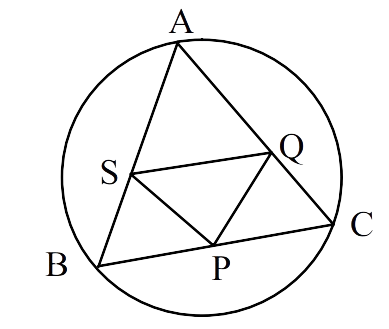
question image △ABC\triangle \mathrm{ABC} এর পরিব্যাসার্ধ R.

Sylhet · 2017

ক
A+B=105∘\mathrm{A}+\mathrm{B}=105^{\circ} হলে sinC⁡\operatorname{sinC} নির্ণয় কর।

উত্তর

দেওয়া আছে, A + B = 105 বা, 180∘−C=105∘[∵A+B+C=180∘]180^{\circ}-\mathrm{C}=105^{\circ}\left[\because \mathrm{A}+\mathrm{B}+\mathrm{C}=180^{\circ}\right] বা, C=75∘\mathrm{C}=75^{\circ} বা, sinC⁡=sin⁡75∘=sin⁡(45∘+30∘)\operatorname{sinC} =\sin 75^{\circ}=\sin \left(45^{\circ}+30^{\circ}\right) =sin⁡45∘cos⁡30∘+cos⁡45∘sin⁡30∘=\sin 45^{\circ} \cos 30^{\circ}+\cos 45^{\circ} \sin 30^{\circ} =12⋅32+12⋅12=3+122 (Ans.) =\frac{1}{\sqrt{2}} \cdot \frac{\sqrt{3}}{2}+\frac{1}{\sqrt{2}} \cdot \frac{1}{2}=\frac{\sqrt{3}+1}{2 \sqrt{2}} \text{ (Ans.) }
খ
△ABC\triangle \mathrm{ABC} এর ক্ষেত্রে প্রমাণ কর যে, a2+b2+c2=8R2(1+cos⁡Acos⁡Bcos⁡C)\mathrm{a}^2+\mathrm{b}^2+\mathrm{c}^2=8 \mathrm{R}^2(1+\cos \mathrm{A} \cos \mathrm{B} \cos \mathrm{C}).

উত্তর

a2+b2+c2\mathrm{a}^2+\mathrm{b}^2+\mathrm{c}^2 =(2Rsin⁡A)2+(2Rsin⁡B)2+(2Rsin⁡C)2=(2 \mathrm{R} \sin \mathrm{A})^2+(2 \mathrm{R} \sin \mathrm{B})^2+(2 \mathrm{R} \sin \mathrm{C})^2 =4R2(sin⁡2 A+sin⁡2 B+sin⁡2C)=4 \mathrm{R}^2\left(\sin^2 \mathrm{~A}+\sin^2 \mathrm{~B}+\sin^2 \mathrm{C}\right) এখন, sin⁡2 A+sin⁡2 B+sin⁡2C\sin^2 \mathrm{~A}+\sin^2 \mathrm{~B}+\sin^2 \mathrm{C} =12(2sin⁡2 A+2sin⁡2 B)+sin⁡2C=\frac{1}{2}\left(2 \sin^2 \mathrm{~A}+2 \sin^2 \mathrm{~B}\right)+\sin^2 \mathrm{C} =12(1−cos⁡2 A+1−cos⁡2 B)+sin⁡2C=\frac{1}{2}(1-\cos 2 \mathrm{~A}+1-\cos 2 \mathrm{~B})+\sin^2 \mathrm{C} =12(2−cos⁡2 A−cos⁡2 B)+sin⁡2C=\frac{1}{2}(2-\cos 2 \mathrm{~A}-\cos 2 \mathrm{~B})+\sin^2 \mathrm{C} =1−12(cos⁡2 A+cos⁡2 B)+sin⁡2C=1-\frac{1}{2}(\cos 2 \mathrm{~A}+\cos 2 \mathrm{~B})+\sin^2 \mathrm{C} =1−12⋅2cos⁡(A+B)cos⁡(A−B)+1−cos⁡2C=1-\frac{1}{2} \cdot 2 \cos (\mathrm{A}+\mathrm{B}) \cos (\mathrm{A}-\mathrm{B})+1-\cos^2 \mathrm{C} =2−cos⁡(π−C)cos⁡(A−B)−cos⁡2C=2-\cos (\pi-\mathrm{C}) \cos (\mathrm{A}-\mathrm{B})-\cos^2 \mathrm{C} =2+cos⁡Ccos⁡(A−B)−cos⁡C=2+\cos \mathrm{C} \cos (\mathrm{A}-\mathrm{B})-\cos \mathrm{C} =2+cos⁡C[cos⁡(A−B)−cos⁡C]=2+\cos \mathrm{C}[\cos (\mathrm{A}-\mathrm{B})-\cos \mathrm{C}] =2+cos⁡C[cos⁡(A−B)+cos⁡(A+B)][∵A+B+C=π]=2+\cos \mathrm{C}[\cos (\mathrm{A}-\mathrm{B})+\cos (\mathrm{A}+\mathrm{B})][\because \mathrm{A}+\mathrm{B}+\mathrm{C}=\pi] =2+cos⁡C⋅2⋅cos⁡A⋅cos⁡B=2+\cos \mathrm{C} \cdot 2 \cdot \cos \mathrm{A} \cdot \cos \mathrm{B} =2+2cos⁡Acos⁡Bcos⁡C=2+2 \cos \mathrm{A} \cos \mathrm{B} \cos \mathrm{C} ∴a2+b2+c2=4R2(2+2cos⁡Acos⁡Bcos⁡C)\therefore \mathrm{a}^2+\mathrm{b}^2+\mathrm{c}^2=4 \mathrm{R}^2(2+2 \cos \mathrm{A} \cos \mathrm{B} \cos \mathrm{C}) ∴a2+b2+c2=8R2(1+cos⁡Acos⁡Bcos⁡C)\therefore \mathrm{a}^2+\mathrm{b}^2+\mathrm{c}^2=8 \mathrm{R}^2(1+\cos \mathrm{A} \cos \mathrm{B} \cos \mathrm{C}) প্রাণিত)
গ
△PQS\triangle \mathrm{PQS} এর ক্ষেত্রে- 1PQ+PS=3PS+PQ+QS−\frac{1}{\mathrm{PQ}+\mathrm{PS}}=\frac{3}{\mathrm{PS}+\mathrm{PQ}+\mathrm{QS}}- 1PS+QS\frac{1}{\mathrm{PS}+\mathrm{QS}} হলে ∠Q\angle \mathrm{Q} নির্ণয় কর।

উত্তর

ΔPQS\Delta \mathrm{PQS} এর PQ=s,QS=p\mathrm{PQ}=\mathrm{s}, \mathrm{QS}=\mathrm{p} এবং PS=q\mathrm{PS}=\mathrm{q} ধরি। প্রশ্নমতে, 1PQ+PS=3PS+PQ+QS−1PS+QS\frac{1}{\mathrm{PQ}+\mathrm{PS}}=\frac{3}{\mathrm{PS}+\mathrm{PQ}+\mathrm{QS}}-\frac{1}{\mathrm{PS}+\mathrm{QS}} বা, 1s+q=3q+s+p−1q+p\frac{1}{s+q}=\frac{3}{q+s+p}-\frac{1}{q+p} বা, 1s+q+1q+p=3q+s+p\frac{1}{s+q}+\frac{1}{q+p}=\frac{3}{q+s+p} বা, \frac{q+p+s+q}{(s+q}(q+p)}=\frac{3}{p+q+s} বা, 2q+p+ssq+sp+q2+pq=3p+q+s\frac{2 q+p+s}{s q+s p+q^2+p q}=\frac{3}{p+q+s} বা, 2pq+2q2+2qs+p2+pq+ps+ps+qs+s22 p q+2 q^2+2 q s+p^2+p q+p s+p s+q s+s^2 =3sq+3sp+3q2+3pq=3 s q+3 s p+3 q^2+3 p q বা, p2+s2−q2=sp\mathrm{p}^2+\mathrm{s}^2-\mathrm{q}^2=\mathrm{sp} বা, p2+s2−q22sp=12\frac{\mathrm{p}^2+\mathrm{s}^2-\mathrm{q}^2}{2 \mathrm{sp}}=\frac{1}{2} বা, cos⁡Q=cos⁡60∘\cos \mathrm{Q}=\cos 60^{\circ} ∴Q=60∘ (Ans.) \therefore \mathrm{Q}=60^{\circ} \text{ (Ans.) }

সম্পূর্ণ প্রশ্ন দেখো

HSCHigher Math 1st Paperসৃজনশীল

উদ্দীপক

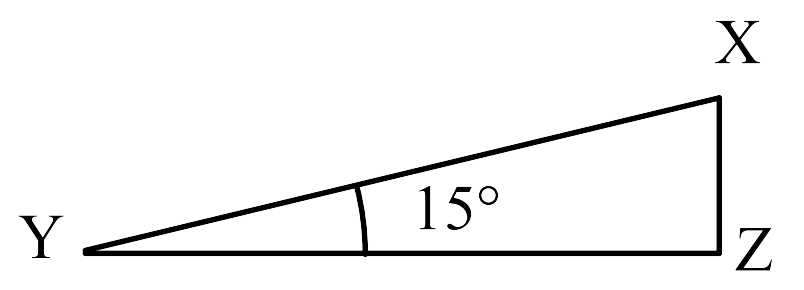
দৃশ্যকল্প-১: question image দৃশ্যকল্প-২: f(x)=12sin⁡x2. \mathrm{f}(\mathrm{x})=\frac{1}{2} \sin \frac{\mathrm{x}}{2} \text{. }

Sylhet · 2017

ক
cos⁡74∘33′cos⁡14∘33′+cos⁡75∘27′cos⁡15∘27′\cos 74^{\circ} 33^{\prime} \cos 14^{\circ} 33^{\prime}+\cos 75^{\circ} 27^{\prime} \cos 15^{\circ} 27^{\prime} এর মান বের কর।

উত্তর

cos⁡74∘33′cos⁡14∘33′+cos⁡75∘27′cos⁡15∘27′=cos⁡(90∘−15∘27′)cos⁡14∘33′+cos⁡(90∘−14∘33′)cos⁡15∘27′=sin⁡15∘27′cos⁡14∘33′+sin⁡14∘33′cos⁡15∘27′=sin⁡(15∘27′+14∘33′)=sin⁡30∘=12 (Ans.) \begin{aligned} & \cos 74^{\circ} 33^{\prime} \cos 14^{\circ} 33^{\prime}+\cos 75^{\circ} 27^{\prime} \cos 15^{\circ} 27^{\prime} \\ & =\cos \left(90^{\circ}-15^{\circ} 27^{\prime}\right) \cos 14^{\circ} 33^{\prime}+\cos \left(90^{\circ}-14^{\circ} 33^{\prime}\right) \cos \\ & 15^{\circ} 27^{\prime} \\ & =\sin 15^{\circ} 27^{\prime} \cos 14^{\circ} 33^{\prime}+\sin 14^{\circ} 33^{\prime} \cos 15^{\circ} 27^{\prime} \\ & =\sin \left(15^{\circ} 27^{\prime}+14^{\circ} 33^{\prime}\right) \\ & =\sin 30^{\circ}=\frac{1}{2} \text{ (Ans.) }\end{aligned}
খ
দৃশ্যকল্প-১ এ যদি cos⁡X=sin⁡Y−cos⁡Z\cos \mathrm{X}=\sin \mathrm{Y}-\cos \mathrm{Z} হয়, তাহলে প্রমাণ কর ∠X+∠Y=∠Z\angle \mathrm{X}+\angle \mathrm{Y}=\angle \mathrm{Z}

উত্তর

দেওয়া আছে, cos⁡X=sin⁡Y−cos⁡Z\cos \mathrm{X}=\sin \mathrm{Y}-\cos \mathrm{Z} বা, cos⁡X+cos⁡Z=sin⁡Y\cos X+\cos Z=\sin Y বা, 2cos⁡X+Z2cos⁡X−Z2=sin⁡22 \cos \frac{X+Z}{2} \cos \frac{X-Z}{2}=\sin 2. Y2\frac{Y}{2} বা, 2sin⁡Y2cos⁡X−Z2=2sin⁡Y2cos⁡Y22 \sin \frac{Y}{2} \cos \frac{X-Z}{2}=2 \sin \frac{Y}{2} \cos \frac{Y}{2} বা, cos⁡X−Z2=cos⁡Y2[∵sin⁡Y2≠0]\cos \frac{X-Z}{2}=\cos \frac{Y}{2}\left[\because \sin \frac{Y}{2} \neq 0\right] বা, sin⁡(π2−X−Z2)=sin⁡(π2+Y2)\sin \left(\frac{\pi}{2}-\frac{X-Z}{2}\right)=\sin \left(\frac{\pi}{2}+\frac{Y}{2}\right) বা, (π2−X−Z2)=(π2+Y2)\left(\frac{\pi}{2}-\frac{X-Z}{2}\right)=\left(\frac{\pi}{2}+\frac{Y}{2}\right) বা, Z−X2=Y2\frac{Z-X}{2}=\frac{Y}{2} বা, Z−X=YZ-X=Y ∴∠X+∠Y=∠Z\therefore \angle \mathrm{X}+\angle \mathrm{Y}=\angle \mathrm{Z} (প্রমাণিত)
গ
দৃশ্যকল্প-২ অনুসারে f(2π−4θ)\mathrm{f}(2 \pi-4 \theta) এর লেখচিত্র অঙ্কন কর। যেখানে −2π≤θ≤2π-2 \pi \leq \theta \leq 2 \pi.

উত্তর

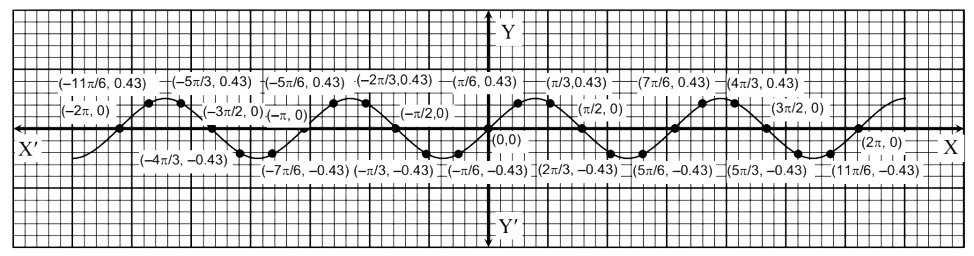
f(x)=12sin⁡x2f(x)=\frac{1}{2} \sin \frac{x}{2} ∴f(2π−4θ)=12sin⁡2π−4θ2=12sin⁡(π−2θ)=12sin⁡2θ\therefore \mathrm{f}(2 \pi-4 \theta)=\frac{1}{2} \sin \frac{2 \pi-4 \theta}{2}=\frac{1}{2} \sin (\pi-2 \theta)=\frac{1}{2} \sin 2 \theta ধরি, y=f(2π−4θ)=12sin⁡2θ\mathrm{y}=\mathrm{f}(2 \pi-4 \theta)=\frac{1}{2} \sin 2 \theta θ=−2π\theta=-2 \pi হতে θ=2π\theta=2 \pi সীমার মধ্যে π6\frac{\pi}{6} ব্যবধানে বিভিন্ন বিন্দুতে y=12sin⁡2θy=\frac{1}{2} \sin 2 \theta এর মান নির্ণয় করি: question image x-অক্ষ বরাবর ক্ষুদ্রতম বর্গের 1 বাহু= π18\frac{\pi}{18} এবং y-অক্ষ বরাবর 5 বাহু=1 একক ধরে প্রদত্ত বিন্দুগুলি ছক কাগজে স্থাপন করি। বিন্দুগুলি যোগ করে প্রদত্ত ফাংশনটির লেখচিত্র অঙ্কন করি। question image

সম্পূর্ণ প্রশ্ন দেখো

HSCHigher Math 1st Paperসৃজনশীল

উদ্দীপক

∠E+∠F=65∘,∠F−∠E=25∘\angle \mathrm{E}+\angle \mathrm{F}=65^{\circ}, \angle \mathrm{F}-\angle \mathrm{E}=25^{\circ}

Jessore · 2017

ক
tan⁡β=13\tan \beta=\frac{1}{3} হলে, sin⁡2β\sin 2 \beta এর মান নির্ণয় কর।

উত্তর

দেওয়া আছে, tan⁡β=13\tan \beta=\frac{1}{3} ∴sin⁡2β=2tan⁡β1+tan⁡2β=2×131+(13)2=23×910=35 (Ans.) \therefore \sin 2 \beta=\frac{2 \tan \beta}{1+\tan^2 \beta}=\frac{2 \times \frac{1}{3}}{1+\left(\frac{1}{3}\right)^2}=\frac{2}{3} \times \frac{9}{10}=\frac{3}{5} \text{ (Ans.) }
খ
দেখাও যে, 2sin⁡(π+F4)=−2−2+22 \sin \left(\pi+\frac{F}{4}\right)=-\sqrt{2-\sqrt{2+\sqrt{2}}}.

উত্তর

∠E+∠F=65∘…… (i) \angle \mathrm{E}+\angle \mathrm{F}=65^{\circ} \ldots \ldots \text{ (i) } ∠F−∠E=25∘…… (ii) \angle \mathrm{F}-\angle \mathrm{E}=25^{\circ} \ldots \ldots \text{ (ii) } (i) ও (ii) নং যোগ করে পাই, 2∠F=90∘∴∠F=45∘2 \angle \mathrm{F}=90^{\circ} \therefore \angle \mathrm{F}=45^{\circ} বামপক্ষ =2sin⁡(π+F4)=−2sin⁡F4=−2sin⁡45∘4=2 \sin \left(\pi+\frac{F}{4}\right)=-2 \sin \frac{F}{4}=-2 \sin \frac{45^{\circ}}{4} =−4sin⁡245∘4=−2.2sin⁡245∘4=−2(1−cos⁡2.45∘4)=-\sqrt{4 \sin^2 \frac{45^{\circ}}{4}}=-\sqrt{2.2 \sin^2 \frac{45^{\circ}}{4}}=-\sqrt{2\left(1-\cos 2 . \frac{45^{\circ}}{4}\right)} =−2−2cos⁡45∘2=−2−4cos⁡245∘2=-\sqrt{2-2 \cos \frac{45^{\circ}}{2}}=-\sqrt{2-\sqrt{4 \cos^2 \frac{45^{\circ}}{2}}} =−2−2.2cos⁡245∘2=−2−2(1+cos⁡2.45∘2)=-\sqrt{2-\sqrt{2.2 \cos^2 \frac{45^{\circ}}{2}}}=-\sqrt{2-\sqrt{2\left(1+\cos 2 . \frac{45^{\circ}}{2}\right)}} =−2−2+2⋅12=−2−2+2==-\sqrt{2-\sqrt{2+2 \cdot \frac{1}{\sqrt{2}}}}=-\sqrt{2-\sqrt{2+\sqrt{2}}}= ডানপক্ষ ∴2sin⁡(π+F4)=−2−2+2\therefore 2 \sin \left(\pi+\frac{F}{4}\right)=-\sqrt{2-\sqrt{2+\sqrt{2}}} (দেখানো হলো)
গ
দেখাও যে, tan⁡∠E⋅tan⁡2∠E⋅tan⁡3∠E⋅tan⁡4∠E=3\tan \angle \mathrm{E} \cdot \tan 2 \angle \mathrm{E} \cdot \tan 3 \angle \mathrm{E} \cdot \tan 4 \angle \mathrm{E}=3.

উত্তর

∠E=65∘−∠F=65∘−45∘=20∘\angle \mathrm{E} =65^{\circ}-\angle \mathrm{F}=65^{\circ}-45^{\circ}=20^{\circ} বামপক্ষ =tan⁡∠Etan⁡2∠Etan⁡3∠Etan⁡4∠E=\tan \angle \mathrm{E} \tan 2 \angle \mathrm{E} \tan 3 \angle \mathrm{E} \tan 4 \angle \mathrm{E} =tan⁡20∘tan⁡40∘tan⁡60∘tan⁡80∘=\tan 20^{\circ} \tan 40^{\circ} \tan 60^{\circ} \tan 80^{\circ} =3tan⁡20∘tan⁡40∘tan⁡80∘=\sqrt{3} \tan 20^{\circ} \tan 40^{\circ} \tan 80^{\circ} =3tan⁡20∘tan⁡(60∘−20∘)tan⁡(60∘+20∘)=\sqrt{3} \tan 20^{\circ} \tan \left(60^{\circ}-20^{\circ}\right) \tan \left(60^{\circ}+20^{\circ}\right) =3tan⁡20∘⋅tan⁡60∘−tan⁡20∘1+tan⁡60∘⋅tan⁡20∘⋅tan⁡60∘+tan⁡20∘1−tan⁡60∘⋅tan⁡20∘=\sqrt{3} \tan 20^{\circ} \cdot \frac{\tan 60^{\circ}-\tan 20^{\circ}}{1+\tan 60^{\circ} \cdot \tan 20^{\circ}} \cdot \frac{\tan 60^{\circ}+\tan 20^{\circ}}{1-\tan 60^{\circ} \cdot \tan 20^{\circ}} =3tan⁡20∘⋅3−tan⁡20∘1+3tan⁡20∘⋅3+tan⁡20∘1−3tan⁡20∘=\sqrt{3} \tan 20^{\circ} \cdot \frac{\sqrt{3}-\tan 20^{\circ}}{1+\sqrt{3} \tan 20^{\circ}} \cdot \frac{\sqrt{3}+\tan 20^{\circ}}{1-\sqrt{3} \tan 20^{\circ}} =3tan⁡20∘⋅(3)2−tan⁡20∘1−(3tan⁡20∘)2=\sqrt{3} \tan 20^{\circ} \cdot \frac{(\sqrt{3})^2-\tan 20^{\circ}}{1-\left(\sqrt{3} \tan 20^{\circ}\right)^2} =3tan⁡20∘⋅3−tan⁡220∘1−3tan⁡220∘=\sqrt{3} \tan 20^{\circ} \cdot \frac{3-\tan^2 20^{\circ}}{1-3 \tan^2 20^{\circ}} =3×3tan⁡20∘−tan⁡320∘1−3tan⁡220∘=\sqrt{3} \times \frac{3 \tan 20^{\circ}-\tan^3 20^{\circ}}{1-3 \tan^2 20^{\circ}} =3tan⁡(3⋅20∘)=3tan⁡40∘=\sqrt{3} \tan \left(3 \cdot 20^{\circ}\right)=\sqrt{3} \tan_4 0^{\circ} =3×3=3=5la⁡∘=\sqrt{3} \times \sqrt{3}=3=5 \operatorname{la}^{\circ} ∴tan⁡∠E⋅tan⁡2∠E⋅tan⁡3∠E⋅tan⁡4∠E=3\therefore \tan \angle \mathrm{E} \cdot \tan 2 \angle \mathrm{E} \cdot \tan 3 \angle \mathrm{E} \cdot \tan 4 \angle \mathrm{E}=3 (দেখানো হলো)

সম্পূর্ণ প্রশ্ন দেখো

HSCHigher Math 1st Paperসৃজনশীল

উদ্দীপক

দৃশ্যকল্প-১: △XYZΩcos⁡X=sin⁡Y−cos⁡Z\triangle \mathrm{XYZ} \Omega \cos \mathrm{X}=\sin \mathrm{Y}-\cos \mathrm{Z}. দৃশ্যকল্প-২: 1+n⋅tan⁡α2=1−n⋅tan⁡β2\sqrt{1+\mathrm{n}} \cdot \tan \frac{\alpha}{2}=\sqrt{1-\mathrm{n}} \cdot \tan \frac{\beta}{2}

Jessore · 2017

ক
প্রমাণ কর যে, tan⁡75∘=2+3\tan 75^{\circ}=2+\sqrt{3}.

উত্তর

tan⁡75∘=tan⁡(45∘+30∘)=tan⁡45∘+tan⁡30∘1−tan⁡45∘tan⁡30∘\tan 75^{\circ}=\tan \left(45^{\circ}+30^{\circ}\right)=\frac{\tan 45^{\circ}+\tan 30^{\circ}}{1-\tan 45^{\circ} \tan 30^{\circ}} =1+131−13=3+133−13=3+13−1=\frac{1+\frac{1}{\sqrt{3}}}{1-\frac{1}{\sqrt{3}}}=\frac{\frac{\sqrt{3}+1}{\sqrt{3}}}{\frac{\sqrt{3}-1}{\sqrt{3}}}=\frac{\sqrt{3}+1}{\sqrt{3}-1} =(3+1)(3+1)(3−1)(3+1)=3+3+3+1(3)2−12=\frac{(\sqrt{3}+1)(\sqrt{3}+1)}{(\sqrt{3}-1)(\sqrt{3}+1)}=\frac{3+\sqrt{3}+\sqrt{3}+1}{(\sqrt{3})^2-1^2} =4+233−1=2(2+3)2=\frac{4+2 \sqrt{3}}{3-1}=\frac{2(2+\sqrt{3})}{2} ∴tan⁡75∘=2+3\therefore \tan 75^{\circ}=2+\sqrt{3} (প্রমাণিত)
খ
দৃশ্যকল্প-১ এর আলোকে দেখাও যে, ত্রিভুজটি সমকোণী।

উত্তর

দেওয়া আছে, cos⁡X=sin⁡Y−cos⁡Z\cos X=\sin Y-\cos Z বা, cos⁡X+cos⁡Z=sin⁡Y\cos X+\cos Z=\sin Y বা, cos⁡X+cos⁡{π−(X+Y)}=sin⁡Y[∵X+Y+Z=π]\cos \mathrm{X}+\cos \{\pi-(\mathrm{X}+\mathrm{Y})\}=\sin \mathrm{Y}[\because \mathrm{X}+\mathrm{Y}+\mathrm{Z}=\pi] বা, cos⁡X−cos⁡(X+Y)=sin⁡Y\cos X-\cos (X+Y)=\sin Y বা, 2sin⁡2X+Y2sin⁡Y2=2sin⁡Y2cos⁡Y22 \sin \frac{2 X+Y}{2} \sin \frac{Y}{2}=2 \sin \frac{Y}{2} \cos \frac{Y}{2} বা, sin⁡(X+Y2)=cos⁡Y2=sin⁡(π2−Y2)\sin \left(X+\frac{Y}{2}\right)=\cos \frac{Y}{2}=\sin \left(\frac{\pi}{2}-\frac{Y}{2}\right) ∴X+Y2=π2−Y2\therefore \quad X+\frac{Y}{2}=\frac{\pi}{2}-\frac{Y}{2} বা, X+Y=π2X+Y=\frac{\pi}{2} ∴Z=π2\therefore \quad \mathrm{Z}=\frac{\pi}{2} অর্থাৎ △XYZ\triangle X Y Z সমকোণী। (দেখানো হলো)
গ
দৃশ্যকল্প-২ এর আলোকে দেখাও যে, cos⁡β=cos⁡α−n1−ncos⁡α\cos \beta=\frac{\cos \alpha-\mathrm{n}}{1-\mathrm{n} \cos \alpha}

উত্তর

দেওয়া আছে, 1+ntan⁡α2=1−n⋅tan⁡β2\sqrt{1+\mathrm{n}} \tan \frac{\alpha}{2}=\sqrt{1-\mathrm{n}} \cdot \tan \frac{\beta}{2} বা, tan⁡α2=1−n1+ntan⁡β2\tan \frac{\alpha}{2}=\sqrt{\frac{1-n}{1+n}} \tan \frac{\beta}{2} বা, tan⁡2α2=1−n1+ntan⁡2β2\tan^2 \frac{\alpha}{2}=\frac{1-n}{1+n} \tan^2 \frac{\beta}{2} বা, tan⁡2β2=1+n1−ntan⁡2α2\tan^2 \frac{\beta}{2}=\frac{1+\mathrm{n}}{1-\mathrm{n}} \tan^2 \frac{\alpha}{2} বা, sin⁡2β2cos⁡2β2=(1+n)sin⁡2α2(1−n)cos⁡2α2\frac{\sin^2 \frac{\beta}{2}}{\cos^2 \frac{\beta}{2}}=\frac{(1+\mathrm{n}) \sin^2 \frac{\alpha}{2}}{(1-\mathrm{n}) \cos^2 \frac{\alpha}{2}} বা, cos⁡2β2sin⁡2β2=(1−n)cos⁡2α2(1+n)sin⁡2α2\frac{\cos^2 \frac{\beta}{2}}{\sin^2 \frac{\beta}{2}}=\frac{(1-n) \cos^2 \frac{\alpha}{2}}{(1+n) \sin^2 \frac{\alpha}{2}} या, cos⁡2β2−sin⁡2β2cos⁡2β2+sin⁡2β2=(1−n)cos⁡2α2−(1+n)sin⁡2α2(1−n)cos⁡2α2+(1+n)sin⁡2α2\frac{\cos^2 \frac{\beta}{2}-\sin^2 \frac{\beta}{2}}{\cos^2 \frac{\beta}{2}+\sin^2 \frac{\beta}{2}}=\frac{(1-n) \cos^2 \frac{\alpha}{2}-(1+n) \sin^2 \frac{\alpha}{2}}{(1-n) \cos^2 \frac{\alpha}{2}+(1+n) \sin^2 \frac{\alpha}{2}} [বিয়োজন-যোজন করে] বা, cos⁡β1=(cos⁡2α2−sin⁡2α2)−n(cos⁡2α2+sin⁡2α2)(cos⁡2α2+sin⁡2α2)−n(cos⁡2α2−sin⁡2α2)\frac{\cos \beta}{1}=\frac{\left(\cos^2 \frac{\alpha}{2}-\sin^2 \frac{\alpha}{2}\right)-n\left(\cos^2 \frac{\alpha}{2}+\sin^2 \frac{\alpha}{2}\right)}{\left(\cos^2 \frac{\alpha}{2}+\sin^2 \frac{\alpha}{2}\right)-n\left(\cos^2 \frac{\alpha}{2}-\sin^2 \frac{\alpha}{2}\right)} ∴cos⁡β=cos⁡α−n1−ncos⁡α\therefore \cos \beta=\frac{\cos \alpha-n}{1-n \cos \alpha} (দেখানো হলো)

সম্পূর্ণ প্রশ্ন দেখো