Read the following text and answer the question no. B: 21 February is observed as Shaheed Dibosh every year throughout the country in remembrance of the martyrs of language movement of 1952. The commemoration [গণিত] at the early hours of the day with mourning songs that recall the supreme sacrifices of our language martyrs. People wear black badges and go [গণিত] the Shaheed Minar in barefoot processions, singing mourning songs. They place wreaths at the Minar. Many of them visit the graves of the martyrs at Azimpur graveyard and pray for them. They also attend various programmes organised in remembrance of the language martyrs. The UNESCO (United Nations Educational, Scientific and Cultural Organisation) on 17 November in 1999 proclaimed February 21 as the International Mother Language Day in recognition of the sacrifices of the martyrs for the rightful place of Bangla. Two Bangladeshi expatriates living in Vancouver in Canada, Rafiqul Islam and Abdus Salam, sent a proposal [গণিত] Kafi Anan, the then Secretary General of United Nations. They requested him [গণিত] declare 21st February as the International Mother Language Day. They added that the decision will honour and save all extinct languages of the world. As per their logical expectations, Prime Minister Sheikh Hasina then took prompt initiative by sending formal proposal [গণিত] UNESCO. Finally, on 17 November 1999, UNESCO declared 21st February as the International Mother Language Day. The day is now annually observed worldwide [গণিত] promote awareness of linguistic and cultural diversity and multilingualism. B. Match the parts of sentences in column A, B and C [গণিত] write five complete sentences. [চিত্র]
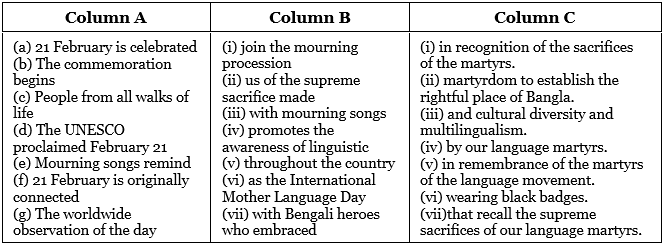
উত্তর: (a) 21 February is celebrated throughout the country in remembrance of the martyrs of the language movement. (b) The commemoration [গণিত] with mourning songs that recall the supreme sacrifices of our language martyrs. (c) People from all walks of life join the mourning procession wearing black badges. (d) The UNESCO proclaimed February 21 as the International Mother Language Day in recognition of the sacrifices of the martyrs. (e) Mourning songs remind us of the supreme sacrifice made by our language martyrs. (f) 21 February is originally connected with Bengali heroes who embraced martyrdom [গণিত] establish the rightful place of Bangla. (g) The worldwide observation of the day promotes the awareness of linguistic and cultural diversity and multilingualism.
SSC ইংরেজি ১ম পত্র CQ — Prosthuti প্রশ্নব্যাংক
SSC · ইংরেজি ১ম পত্র · সৃজনশীল
Read the following text and answer the question no. B:
21 February is observed as Shaheed Dibosh every year throughout the country in remembrance of the martyrs of language movement of 1952. The commemoration \begin{s}at the early hours of the day with mourning songs that recall the supreme sacrifices of our language martyrs. People wear black badges and go processions, singing mourning songs. They place wreaths at the Minar. Many of them visit the graves of the martyrs at Azimpur graveyard and pray for them. They also attend various programmes organised in remembrance of the language martyrs.
The UNESCO (United Nations Educational, Scientific and Cultural Organisation) on 17 November in 1999 proclaimed February 21 as the International Mother Language Day in recognition of the sacrifices of the martyrs for the rightful place of Bangla. Two Bangladeshi expatriates living in Vancouver in Canada, Rafiqul Islam and Abdus Salam, sent a proposal Anan, the then Secretary General of United Nations. They requested him Day. They added that the decision will honour and save all extinct languages of the world. As per their logical expectations, Prime Minister Sheikh Hasina then took prompt initiative by sending formal proposal UNESCO. Finally, on 17 November 1999, UNESCO declared 21st February as the International Mother Language Day. The day is now annually observed worldwide multilingualism.
B. Match the parts of sentences in column A, B and C sentences.
উত্তর