
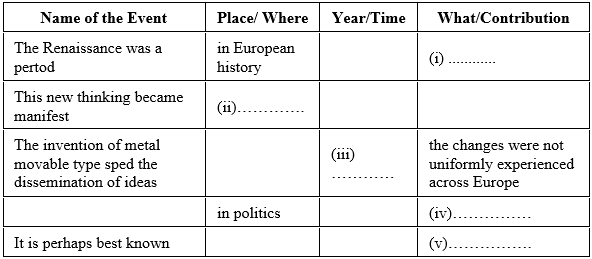
Read the following text carefully and answer questions A and B. The Renaissance was a period in European history, from the 14th [গণিত] the 17th century, regarded as the cultural bridge between the middle ages and modern history. It started as a cultural movement in Italy in the Medieval period and later spread [গণিত] the rest of Europe, marking the [গণিত] of the modern age. The intellectual basis of the Renaissance was its own invented version of humanism, derived from the concept of Roman humanities and the rediscovery of classical Greek philosophy, such as that of Protagoras, who said that "Man is the measure of all things." This new thinking became manifest in art, architecture, politics, science and literature. Early examples were the development of perspective in oil painting and the recycled knowledge of how [গণিত] make concrete. Although the invention of metal movable type sped the dissemination of ideas from the later 15th century, the changes of the Renaissance were not uniformly experienced across Europe. As a cultural movement, the Renaissance encompassed innovative flowering of Latin and vernacular literatures, [গণিত] with the 14th century resurgence of learning based on classical sources, which contemporaries credited [গণিত] Petrarch; the development of liner perspective and other techniques of rendering a more natural reality in painting: and gradual but widespread educational reform. In politics, the Renaissance contributed [গণিত] the development of the customs and conventions of diplomacy, and in science [গণিত] an increased reliance on observation and inductive reasoning. Although the Renaissance saw revolutions in many intellectual pursuits [গণিত] as well as social and political upheaval, it is perhaps best known for its artistic developments and the contributions of such polymaths as Leonardo da Vinci and Michael Angelo, who inspired the term "Renaissance man," A. Complete the table below with the information from the above passage. [চিত্র]
উত্তর: (i) humanism; (ii) in art, architecture, literature, politics and science; (iii) from the 14th to the 17th century; (iv) the development of the customs and conventions of diplomacy; (v) artistic achievement.
SSC ইংরেজি ১ম পত্র CQ — Prosthuti প্রশ্নব্যাংক
SSC · ইংরেজি ১ম পত্র · সৃজনশীল
Read the following text carefully and answer questions A and B.
The Renaissance was a period in European history, from the 14th century, regarded as the cultural bridge between the middle ages and modern history. It started as a cultural movement in Italy in the Medieval period and later spread Europe, marking the \begin{ning}of the modern age. The intellectual basis of the Renaissance was its own invented version of humanism, derived from the concept of Roman humanities and the rediscovery of classical Greek philosophy, such as that of Protagoras, who said that "Man is the measure of all things." This new thinking became manifest in art, architecture, politics, science and literature. Early examples were the development of perspective in oil painting and the recycled knowledge of how concrete. Although the invention of metal movable type sped the dissemination of ideas from the later 15th century, the changes of the Renaissance were not uniformly experienced across Europe. As a cultural movement, the Renaissance encompassed innovative flowering of Latin and vernacular literatures, \begin{ning}with the 14th century resurgence of learning based on classical sources, which contemporaries credited Petrarch; the development of liner perspective and other techniques of rendering a more natural reality in painting: and gradual but widespread educational reform. In politics, the Renaissance contributed diplomacy, and in science reasoning. Although the Renaissance saw revolutions in many intellectual upheaval, it is perhaps best known for its artistic developments and the contributions of such polymaths as Leonardo da Vinci and Michael Angelo, who inspired the term "Renaissance man,"
A. Complete the table below with the information from the above passage.
উত্তর