শেয়ারFacebookWhatsApp

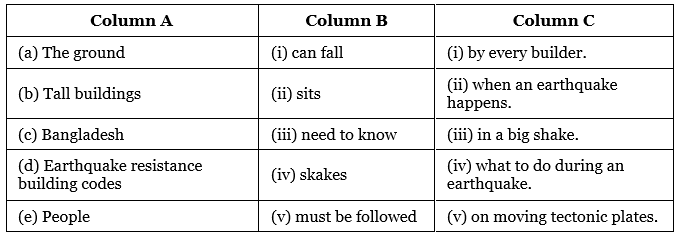
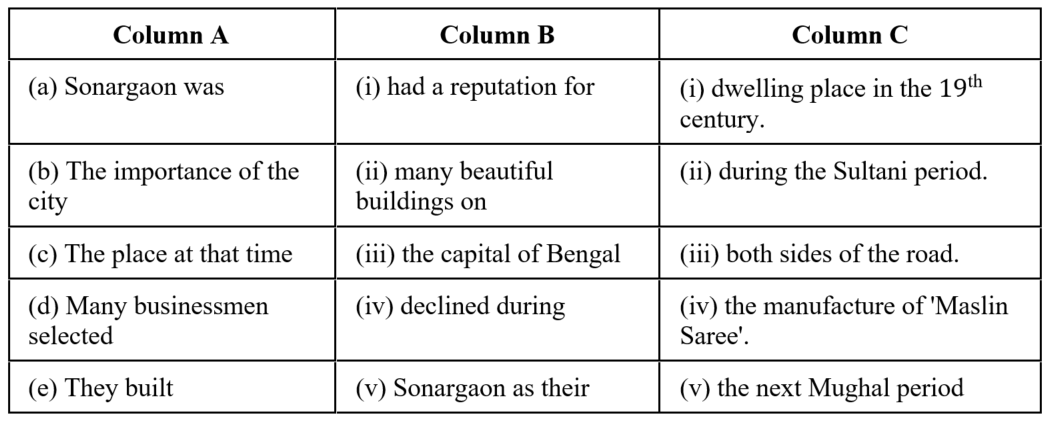
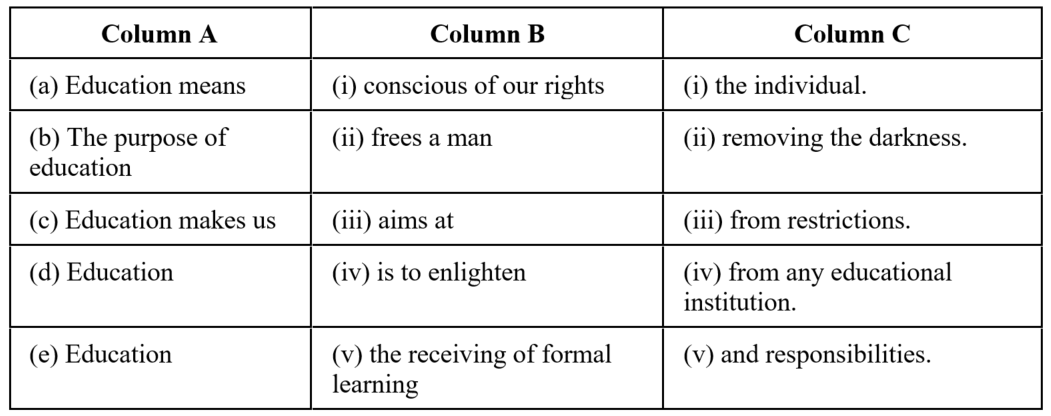
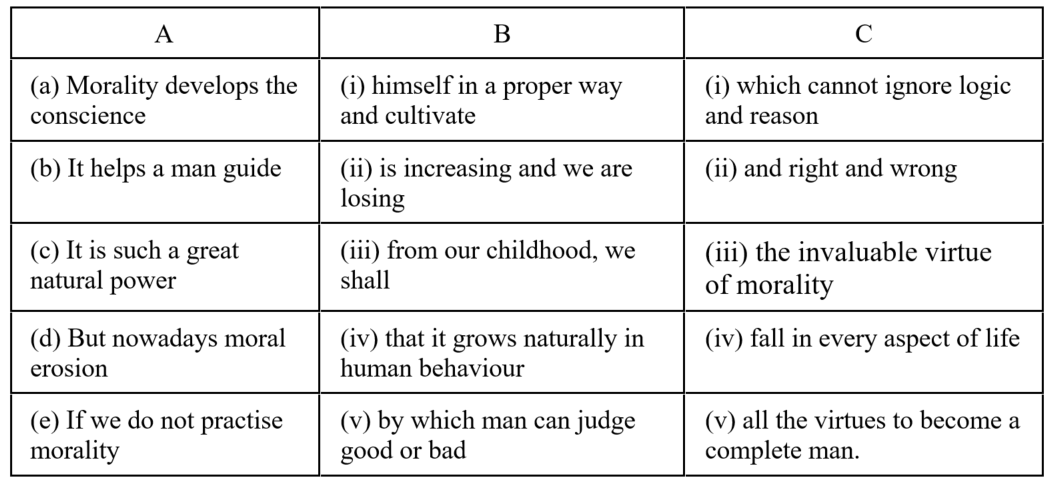
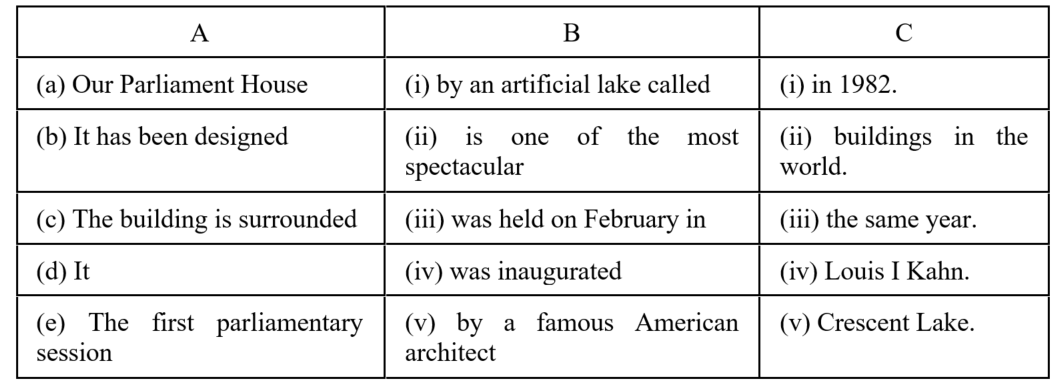
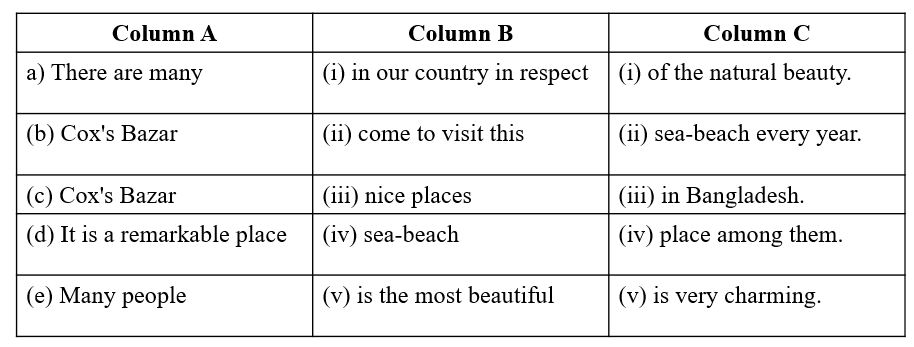
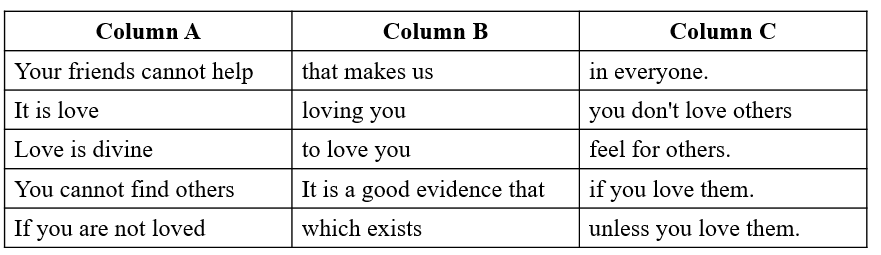
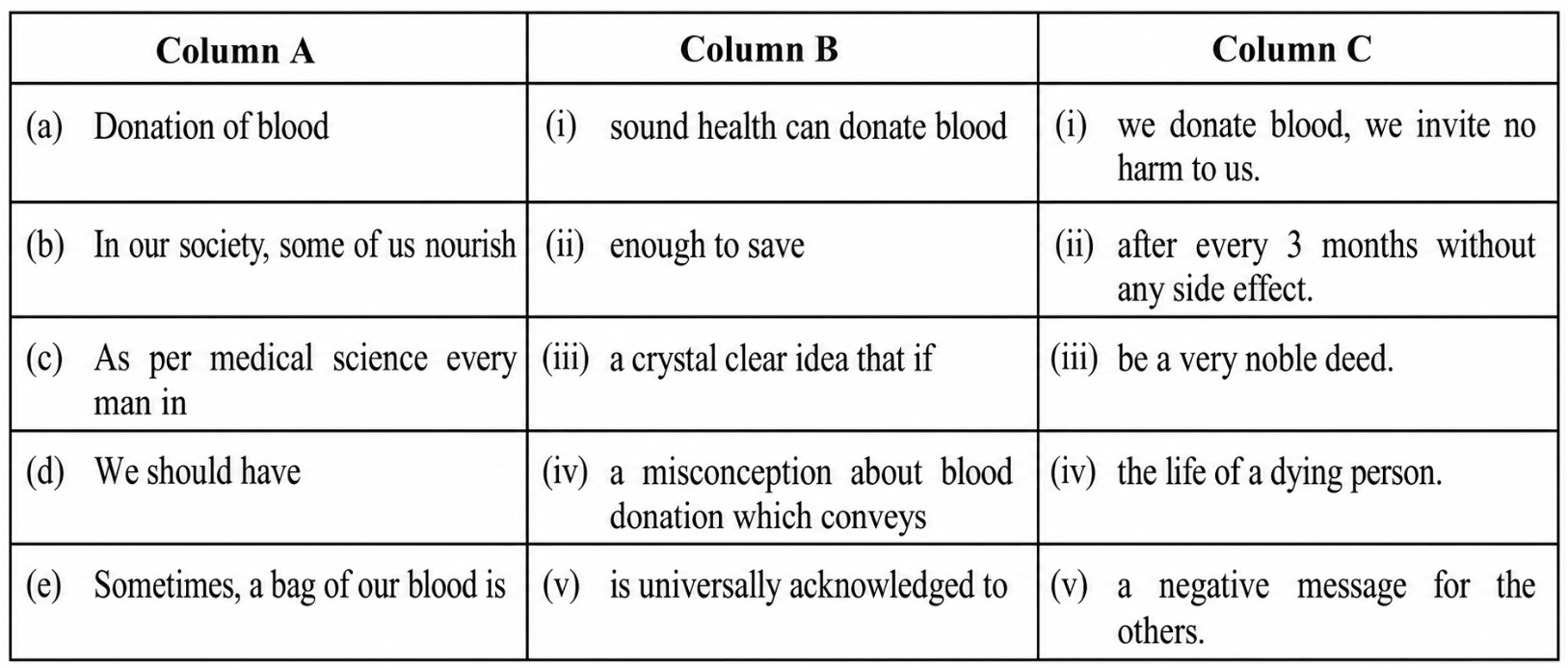
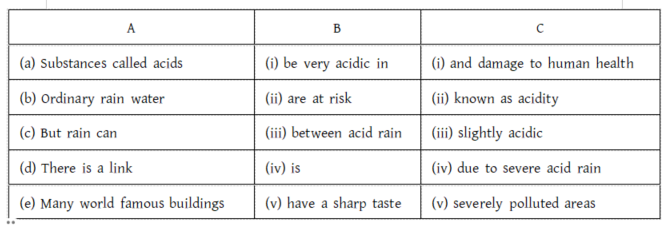
Match the parts of sentences given in column 'A [গণিত] , 'B [গণিত] and 'C [গণিত] write five complete sentences. [চিত্র]

উত্তর: (a + iv + ii) (b + i + iii) (c + ii + v) (d + v + i) (e + iii + iv)
SSC English 1st Paper Matching the parts of sentences CQ — Prosthuti প্রশ্নব্যাংক

SSC · English 1st Paper · Matching the parts of sentences · সৃজনশীল

Match the parts of sentences given in column 'A′,A^{\prime}, 'B′andB^{\prime} and 'C′→writefivecompleteC^{\prime} \to write five complete sentences. question image

উত্তর

(a + iv + ii) (b + i + iii) (c + ii + v) (d + v + i) (e + iii + iv)
SSCEnglish 1st PaperMatching the parts of sentences
12টি সম্পর্কিত প্রশ্ন — ব্যাখ্যা লকড

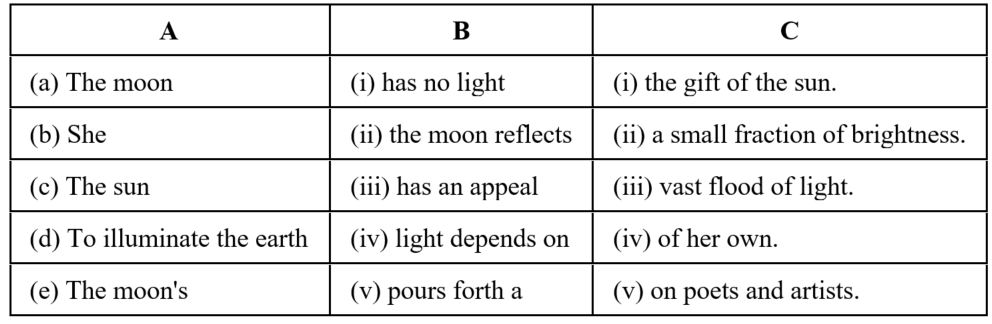
1.Match the parts of sentences in column A, B and C →writefivecomplete\to write five complete sentences:question image

Match the parts of sentences in column A, B and C →writefivecomplete\to write five complete sentences:question image

উত্তর ও ব্যাখ্যা দেখতে ফ্রি রেজিস্ট্রেশন করো

ফ্রি শুরু করো

2.Match the parts of sentences in column A, B and C →writefivecomplete\to write five complete sentences. question image

Match the parts of sentences in column A, B and C →writefivecomplete\to write five complete sentences. question image

উত্তর ও ব্যাখ্যা দেখতে ফ্রি রেজিস্ট্রেশন করো

ফ্রি শুরু করো

3.Match the parts of sentences in column A, B and C →writefivecomplete\to write five complete sentences. question image

Match the parts of sentences in column A, B and C →writefivecomplete\to write five complete sentences. question image

উত্তর ও ব্যাখ্যা দেখতে ফ্রি রেজিস্ট্রেশন করো

ফ্রি শুরু করো

4.Match the parts of sentences given in Column A, B and C →writefivecomplete\to write five complete sentences. question image

Match the parts of sentences given in Column A, B and C →writefivecomplete\to write five complete sentences. question image

উত্তর ও ব্যাখ্যা দেখতে ফ্রি রেজিস্ট্রেশন করো

ফ্রি শুরু করো

5.Match the parts of sentences in column A, B and C →writefivecomplete\to write five complete sentences. question image

Match the parts of sentences in column A, B and C →writefivecomplete\to write five complete sentences. question image

উত্তর ও ব্যাখ্যা দেখতে ফ্রি রেজিস্ট্রেশন করো

ফ্রি শুরু করো

6.Match the parts of the sentences given in column A, B and C →writefivecomplete\to write five complete sentences. question image

Match the parts of the sentences given in column A, B and C →writefivecomplete\to write five complete sentences. question image

উত্তর ও ব্যাখ্যা দেখতে ফ্রি রেজিস্ট্রেশন করো

ফ্রি শুরু করো

7.Match the parts of sentences given in column 'A′,A^{\prime}, 'B′andB^{\prime} and 'C′→writefivecompleteC^{\prime} \to write five complete sentences. question image

Match the parts of sentences given in column 'A′,A^{\prime}, 'B′andB^{\prime} and 'C′→writefivecompleteC^{\prime} \to write five complete sentences. question image

উত্তর ও ব্যাখ্যা দেখতে ফ্রি রেজিস্ট্রেশন করো

ফ্রি শুরু করো

8.Match the parts of sentences given in column A, B and C →writefivecomplete\to write five complete sentences. question image

Match the parts of sentences given in column A, B and C →writefivecomplete\to write five complete sentences. question image

উত্তর ও ব্যাখ্যা দেখতে ফ্রি রেজিস্ট্রেশন করো

ফ্রি শুরু করো

9.Match the parts of the sentences in column A, B and C →writefivecomplete\to write five complete sentences: question image

Match the parts of the sentences in column A, B and C →writefivecomplete\to write five complete sentences: question image

উত্তর ও ব্যাখ্যা দেখতে ফ্রি রেজিস্ট্রেশন করো

ফ্রি শুরু করো

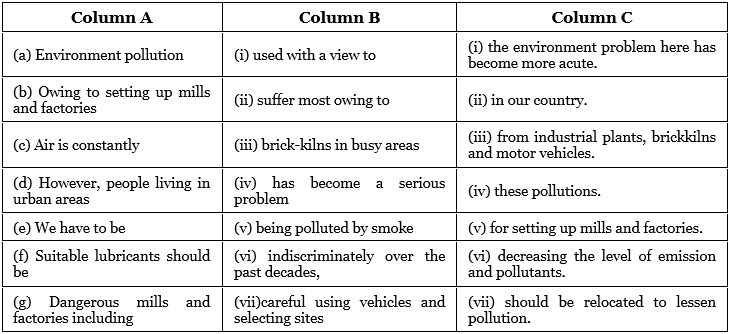
10.Read the following passage and answer the questions no. B : Air pollution comes from a wide variety of sources. In Bangladesh poisonous exhaust from industrial plants, brickkilns, old or poorly-serviced vehicles and dust from roads and construction sites are some of the major sources of air pollution. We can minimise this type of pollution by making less use of motor vehicles and avoiding the use of vehicles older than 20 years. We may also use proper lubricants →lessenthelevelofemissionand\to lessen the level of emission and pollutants. We can encourage people →useCompressedNaturalGas(CNG)orLiquidPetroleumGas(LPG)forfuellingtheir\to use Compressed Natural Gas (CNG) or Liquid Petroleum Gas (LPG) for fuelling their cars. The government may relocate hazardous industries like brick kilns →areasawayfromhuman\to areas away from human habitations. B. Match the parts of sentences in column A, B and C →writefivecomplete\to write five complete sentences. question image

Read the following passage and answer the questions no. B : Air pollution comes from a wide variety of sources. In Bangladesh poisonous exhaust from industrial plants, brickkilns, old or poorly-serviced vehicles and dust from roads and construction sites are some of the major sources of air pollution. We can minimise this type of pollution by making less use of motor vehicles and avoiding the use of vehicles older than 20 years. We may also use proper lubricants →lessenthelevelofemissionand\to lessen the level of emission and pollutants. We can encourage people →useCompressedNaturalGas(CNG)orLiquidPetroleumGas(LPG)forfuellingtheir\to use Compressed Natural Gas (CNG) or Liquid Petroleum Gas (LPG) for fuelling their cars. The government may relocate hazardous industries like brick kilns →areasawayfromhuman\to areas away from human habitations. B. Match the parts of sentences in column A, B and C →writefivecomplete\to write five complete sentences. question image

উত্তর ও ব্যাখ্যা দেখতে ফ্রি রেজিস্ট্রেশন করো

ফ্রি শুরু করো

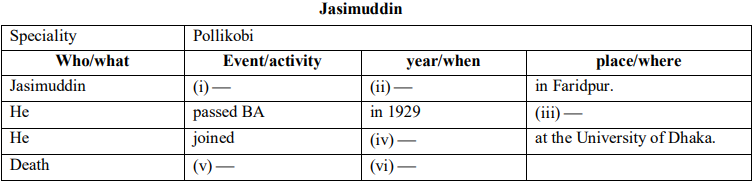
11.Read the following text carefully and answer the questions no. A: Jasimuddin was a famous Bangalee poet. He was also a song writer, folklore collector and radio personality. He is known as 'Pollikobi′becausethroughhisPollikobi^{\prime} because through his poems, he depicted the Bengali rural life. He was born in the village of Tambulkhana in Faridpur district on 1 January 1903. He received his early education at Faridpur Welfare School. He obtained BA degree in Bangla from the University of Kolkata in 1929 and MA in 1931. Jasimuddin joined the University of Dhaka in 1938 as a Lecturer of Bangla. He \left the University in 1944 and joined the Department of Information and Broadcasting. He worked there till his retirement in 1962 as Deputy Director. Jasimuddin collected more than 10,000 folk songs. He wrote poems, novels, memoirs, music etc. His major works are Rakhali, Nakshi Kanthar Maath, Sojan Badiyar Ghat, Beder Meye and Madhumala. The major honours and awards that he received are President Award for pride performance, Pakistan (1958), D.Litt by Rabindra Bharati University, India (1969), Ekushey Padak (1976), and Independence Day Award (1978). He died on 13 March 1976 and was buried near his ancestral home at Gobindapur. A. Complete the table below with information from the above passage: question image

Read the following text carefully and answer the questions no. A: Jasimuddin was a famous Bangalee poet. He was also a song writer, folklore collector and radio personality. He is known as 'Pollikobi′becausethroughhisPollikobi^{\prime} because through his poems, he depicted the Bengali rural life. He was born in the village of Tambulkhana in Faridpur district on 1 January 1903. He received his early education at Faridpur Welfare School. He obtained BA degree in Bangla from the University of Kolkata in 1929 and MA in 1931. Jasimuddin joined the University of Dhaka in 1938 as a Lecturer of Bangla. He \left the University in 1944 and joined the Department of Information and Broadcasting. He worked there till his retirement in 1962 as Deputy Director. Jasimuddin collected more than 10,000 folk songs. He wrote poems, novels, memoirs, music etc. His major works are Rakhali, Nakshi Kanthar Maath, Sojan Badiyar Ghat, Beder Meye and Madhumala. The major honours and awards that he received are President Award for pride performance, Pakistan (1958), D.Litt by Rabindra Bharati University, India (1969), Ekushey Padak (1976), and Independence Day Award (1978). He died on 13 March 1976 and was buried near his ancestral home at Gobindapur. A. Complete the table below with information from the above passage: question image

উত্তর ও ব্যাখ্যা দেখতে ফ্রি রেজিস্ট্রেশন করো

ফ্রি শুরু করো

12.Read the following text carefully and answer the questions no. A: Jasimuddin was a famous Bangalee poet. He was also a song writer, folklore collector and radio personality. He is known as 'Pollikobi′becausethroughhisPollikobi^{\prime} because through his poems, he depicted the Bengali rural life. He was born in the village of Tambulkhana in Faridpur district on 1 January 1903. He received his early education at Faridpur Welfare School. He obtained BA degree in Bangla from the University of Kolkata in 1929 and MA in 1931. Jasimuddin joined the University of Dhaka in 1938 as a Lecturer of Bangla. He \left the University in 1944 and joined the Department of Information and Broadcasting. He worked there till his retirement in 1962 as Deputy Director. Jasimuddin collected more than 10,000 folk songs. He wrote poems, novels, memoirs, music etc. His major works are Rakhali, Nakshi Kanthar Maath, Sojan Badiyar Ghat, Beder Meye and Madhumala. The major honours and awards that he received are President Award for pride performance, Pakistan (1958), D.Litt by Rabindra Bharati University, India (1969), Ekushey Padak (1976), and Independence Day Award (1978). He died on 13 March 1976 and was buried near his ancestral home at Gobindapur. A. Complete the table below with information from the above passage: question image

Read the following text carefully and answer the questions no. A: Jasimuddin was a famous Bangalee poet. He was also a song writer, folklore collector and radio personality. He is known as 'Pollikobi′becausethroughhisPollikobi^{\prime} because through his poems, he depicted the Bengali rural life. He was born in the village of Tambulkhana in Faridpur district on 1 January 1903. He received his early education at Faridpur Welfare School. He obtained BA degree in Bangla from the University of Kolkata in 1929 and MA in 1931. Jasimuddin joined the University of Dhaka in 1938 as a Lecturer of Bangla. He \left the University in 1944 and joined the Department of Information and Broadcasting. He worked there till his retirement in 1962 as Deputy Director. Jasimuddin collected more than 10,000 folk songs. He wrote poems, novels, memoirs, music etc. His major works are Rakhali, Nakshi Kanthar Maath, Sojan Badiyar Ghat, Beder Meye and Madhumala. The major honours and awards that he received are President Award for pride performance, Pakistan (1958), D.Litt by Rabindra Bharati University, India (1969), Ekushey Padak (1976), and Independence Day Award (1978). He died on 13 March 1976 and was buried near his ancestral home at Gobindapur. A. Complete the table below with information from the above passage: question image

উত্তর ও ব্যাখ্যা দেখতে ফ্রি রেজিস্ট্রেশন করো

ফ্রি শুরু করো

আরো প্রশ্ন দেখো

আরো হাজারো প্রশ্ন + মডেল টেস্ট

ফ্রি রেজিস্ট্রেশন করো — ফেভারিট, AI টিউটর, লিডারবোর্ড ও অ্যানালিটিক্স আনলক করো।