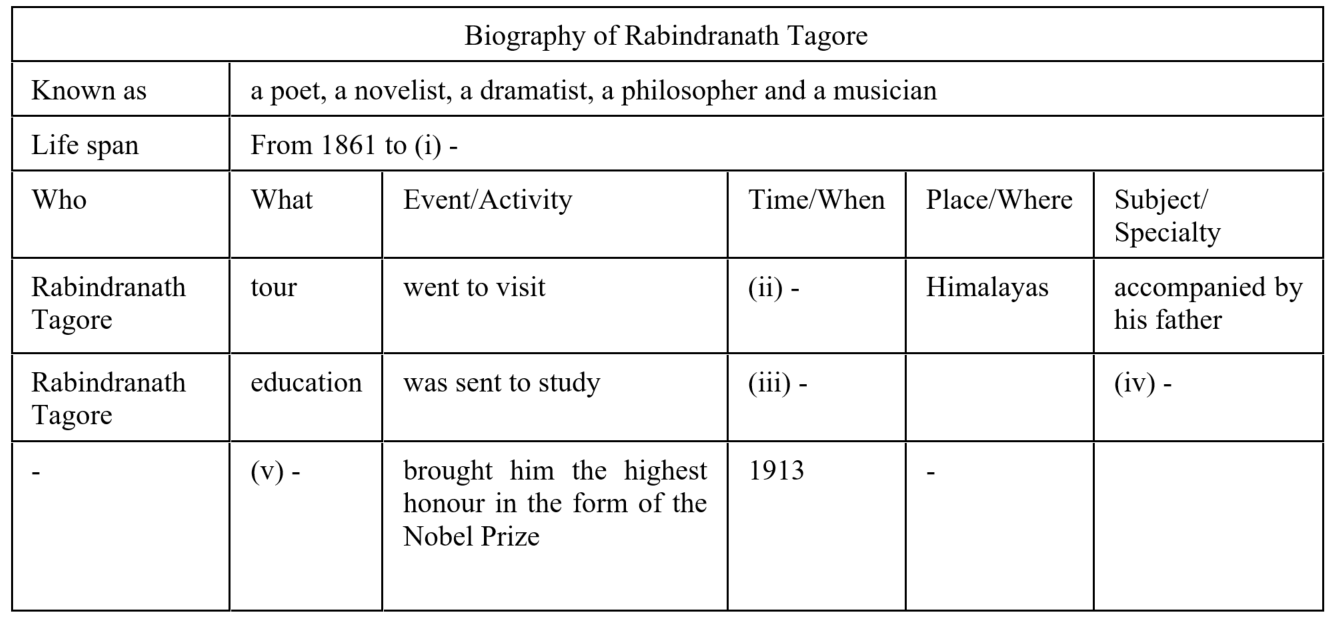
Read the following passage and answer the questions Rabindranath Tagore was one of the most leading poets in the history of world literature. He was at the same time a poet, a novelist, a dramatist, a philosopher and a musician. He was born in the renowned Tagore family in March, 1861. After the completion of his house education, he was sent to school. But he did not like institutional education So arrangements were made at house for his proper education. In his thirteenth year, Rabindranath along with his father went to visit Himalayas. At the age of seventeen, he was sent to London to study law. But he studied literature with professor Henry Morley only for a few months and then returned home. Only at the age of eight he started composing poems. He wrote his poetic novel Banaphul at the age of fifteen. When he was sixteen, his poems and essays were being published in journals. After returning from England, he began to write tirelessly in all branches of literature. In 1911 he translated his poems of "The Gitanjali" into English which brought him the highest honour in the form of the Nobel Prize in 1913. One year after his awarding of the Nobel Prize, he was made a knight by the British Government which he rejected as a protest against the atrocities of British Government at Jalianwalabagh. The University of Oxford honoured him with D.Litt., in 1940. Earlier in 1921, he laid the foundation of Viswa Bharati. At the age of eighty, Rabindranath Tagore breathed his last. Write a summary of the above passage in your own words.
উত্তর: Rabindranath Tagore, a poet, novelist, dramatist, philosopher and musician, was born in a renowned Tagore family in 1861. School life did not attract him much and so, he was educated at home. However, at 17, he was sent [গণিত] London [গণিত] study Law. But he started [গণিত] study Literature with professor Henry Morley there. Rabindranath started [গণিত] show his poetic flair very early in his life. In 1911, he translated 'The Gitanjali [গণিত] into English for which he was awarded the Nobel Prize in 1913. The following year, he was made a knight by the British Government but he rejected it as a protest against the British atrocities. Rabindranath passed away in 1941.
SSC English 1st Paper Seen Comprehension-2 CQ — Prosthuti প্রশ্নব্যাংক
SSC · English 1st Paper · Seen Comprehension-2 · সৃজনশীল
Read the following passage and answer the questions Rabindranath Tagore was one of the most leading poets in the history of world literature. He was at the same time a poet, a novelist, a dramatist, a philosopher and a musician. He was born in the renowned Tagore family in March, 1861. After the completion of his house education, he was sent to school. But he did not like institutional education So arrangements were made at house for his proper education. In his thirteenth year, Rabindranath along with his father went to visit Himalayas. At the age of seventeen, he was sent to London to study law. But he studied literature with professor Henry Morley only for a few months and then returned home. Only at the age of eight he started composing poems. He wrote his poetic novel Banaphul at the age of fifteen. When he was sixteen, his poems and essays were being published in journals. After returning from England, he began to write tirelessly in all branches of literature. In 1911 he translated his poems of "The Gitanjali" into English which brought him the highest honour in the form of the Nobel Prize in 1913. One year after his awarding of the Nobel Prize, he was made a knight by the British Government which he rejected as a protest against the atrocities of British Government at Jalianwalabagh. The University of Oxford honoured him with D.Litt., in 1940. Earlier in 1921, he laid the foundation of Viswa Bharati. At the age of eighty, Rabindranath Tagore breathed his last. Write a summary of the above passage in your own words.
উত্তর