
Who followed the call of trade unions?
ক. Farmers
খ. Workers
গ. Owners
ঘ. Strikers
উত্তর: Workers
SSC English 1st Paper Seen Comprehension-1 MCQ — Prosthuti প্রশ্নব্যাংক
SSC · English 1st Paper · Seen Comprehension-1 · MCQ
Who followed the call of trade unions?
ক. Farmers
খ. Workers
গ. Owners
ঘ. Strikers
উত্তর: Workers
SSC English 1st Paper Seen Comprehension-1 MCQ — Prosthuti প্রশ্নব্যাংক
SSC · English 1st Paper · Seen Comprehension-1 · MCQ
1.Read the passage and answer the question A . [Unit-2; Lesson-3(A)] Humans can neither change the sun's radiation nor the earth's orbit around the sun. But they can control the increase in the amount of greenhouse gases and its effect on the atmosphere. Only during the last hundred years the carbon dioxide concentration has been raised alarmingly in the atmosphere and we humans can be held responsible for this. The main cause of the increase in carbon dioxide level in the atmosphere is the burning of fossil fuels. Since the \end{of}the 19th century, industrial activities increased rapidly giving rise factories. These factories required energy, which was produced through the combustion of coal. Besides coal, other sources of energy such as mineral oil and natural gas were also burned houses, run cars and airplanes or electricity. Nowadays, about 85 million barrels of crude oil are burned daily. Every time a fossil raw material is burned, it releases carbon dioxide into the air. Therefore, it is clear that more and more greenhouse gases like carbon dioxide are being generated worldwide by humans. Moreover, we are also strengthening the greenhouse effect by deforestation, which means cutting down trees. Every year enormous areas of forests are destroyed by people pasture. This loss of the forest causes dual problems. Trees that are burned up release large volumes of carbon dioxide gas into the air. On the other hand, as forests absorb a lot of carbon dioxide from the air and deliver oxygen instead, we also destroy an important storehouse of carbon dioxide when we clear forests. A. Answer the following questions. (a) How does the burning of fossil fuels since the Industrial Revolution illustrate the direct between human progress and environmental degradation? (b) In what ways does deforestation create a dual impact on the concentration of carbon dioxide in the atmosphere? (c) Evaluate how industrialization and modernization have collectively intensified the greenhouse effect over the past century. (d) How are htımans producing a great amount of carbon dioxide daily? (e) How can we stop the emission of greenhouse gases?
উত্তর ও ব্যাখ্যা দেখতে ফ্রি রেজিস্ট্রেশন করো
ফ্রি শুরু করো2.Read the passage carefully and answer question B. [Unit-16] Graffiti's potency lies in its subversive, guerrilla nature. Unlike wall art, which is typically organized and sanctioned, graffiti thrives on immediacy, spontaneity, and the risk of persecution. Where wall art may take time and care, graffiti is often quick, requiring speed and anonymity due detection. Its purpose is power, counter surveillance, and inscribe messages that are otherwise censored or suppressed. The July Uprising brought new dimensions dissent. Spray-painted slogans defied erasure, embodying collective rage and revolutionary solidarity. Demands like "Ek dofa, ek dabi, shoirachar tul kobe Jabi?" surfaced as cries for justice, echoing the French philosopher Jacques Derrida's assertion that "What cannot be said... must not be silenced but written." A strong sense of inclusivity was also reflected in the wall art and graffiti during and after the July Uprising, which highlighted the case of the marginalized and minoritized people in multiple instances. Numerous graffiti and wall art pieces not only called for justice but also carried a broader message of liberation, "Not a land of one nation, Bangladesh is a land of many communities" symbolizing the interconnected struggles of all communities. It underscored the message i.e. our collective liberation is intertwined, with the fight for justice uniting people across regions and backgrounds. The true power of graffiti lies in its resilience; it persists as a medium for revolutionary memory and collective consciousness. It speaks for those silenced, ensures the struggles of the marginalized \end{ure}, and, as Banksy's words suggest, comforts the disturbed while disturbing the comfortable. B. Answer the following questions in your own words. (a) Why is graffiti called a subversive art form? (b) Why is speed important in graffiti creation? (c) How does graffiti resist censorship? (d) Why is graffiti important for marginalized community (e) Why is graffiti considered resilient?
উত্তর ও ব্যাখ্যা দেখতে ফ্রি রেজিস্ট্রেশন করো
ফ্রি শুরু করো3.Write a summary of the above passage in your own words.
উত্তর ও ব্যাখ্যা দেখতে ফ্রি রেজিস্ট্রেশন করো
ফ্রি শুরু করো4.Read the passage and answer questions A and B.
Stephen Hawking is considered the greatest physicist after Einstein. He was born in England in 1942. He was very skilled in mathematics from an early age. He wrote the book "A Brief History of Time: From the Big Bang Holes" in 1988. In this book he explains Cosmology for the general public. It became famous and established his reputation as a great scientist. He received his PhD in Cosmology from Cambridge University in 1968. But fortune did not favour him. In 1972, he became a victim of Gehrig's disease. Since then, he has been confined body. But he continued his teaching through the help of a computer. In 1974, he won the prestigious Albert Einstein Award for theoretical physics. In 1979, he joined Cambridge University as Lucasian Professor of Mathematics. He carried out his research work using his computer. This great scientist breathed his last on 14 March 2018.
Complete the table below with information given in the passage.
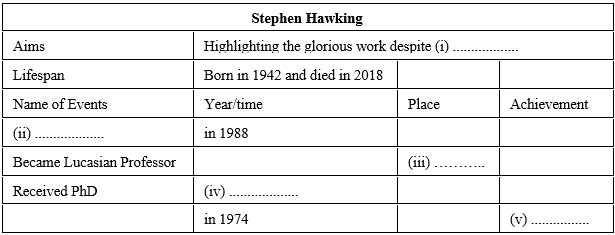
উত্তর ও ব্যাখ্যা দেখতে ফ্রি রেজিস্ট্রেশন করো
ফ্রি শুরু করো5.Fill in each gap with a suitable word based on the text. Zahir Raihan is a great son of our country. He was basically a (a) — film maker. He also wrote a number of novels. Besides, he was an (b) — worker in organizing the Language Movement that ultimately (c) — to the War of Liberation. He was a dreamer of Independence. He played a very important role. He made a documentary film on the (d) — Pakistanis did on the Bangalees in 1971 during the war. He did all these noble things to have an (e) — and democratic country.
উত্তর ও ব্যাখ্যা দেখতে ফ্রি রেজিস্ট্রেশন করো
ফ্রি শুরু করো6.Read the passage. Then answer questions B and C. [Unit-10; Lesson-4(B)] Zahir Raihan was one of the most talented film makers in Bangladesh. He was born on 19 August 1935 in the village Majupur in Feni district. He was an active worker of the Language Movement. He was one of the ten students authorities. As a result, he and many others were arrested and taken prison. Raihan was also present at the historical meeting of Amtala on 21 February 1952. He also took part in the Mass Movement in 1969. In 1971, he joined the Liberation War. All through his life, Zahir Raihan dreamt of a democratic society, a society that would ensure freedom of speech. He had many dreams about our film industry too. He made a legendary film Jibon Theke Neya based on the Language Movement of 1952. It was a protest against the autocratic government then ruling our country. The family portrayed in that film symbolically represented East Pakistan. The family was ruled by an autocrat who had conspiracy. During the Liberation War in 1971, this film was shown outside Bangladesh. Celebrated film makers like Satyajit Ray. Mrinal Sen, and Ritwik Ghatak appreciated the film. Rathan gave all the money the film made trust. Besides, his great documentary on Pakistani atrocities, Stop Genocide, helped create world sentiment in favour of our Liberation War. On 30 December 1971, someone informed Raihan about an address somewhere at Mirpur, where he might find his brother, the famous writer Shahidullah Kaiser, who had gone missing from 14 December 1971. Kaiser was captured and killed by the Pakistani Army and the local collaborators during the last days of the war. Accordingly. Raihan \left home \to get his brother back but he never returned. Zahir Raihan's dream was fulfilled. But it's a pity that this dreamer could not live true. B. Answer the following questions. (a) What did Zahir dream all through his life? (b) How did he create world sentiment in favour of our Liberation War? (c) Where does Zahir Raihan hail from? (d) From your reading of paragraph 2, give an account of the legendary film Jibon Theke Neya. (e) Do you think Zahir Raihan was a freedom fighter? Why/Why not?
উত্তর ও ব্যাখ্যা দেখতে ফ্রি রেজিস্ট্রেশন করো
ফ্রি শুরু করো7.Fill in the gaps with right words based on the passage's information. Loneliness is a feeling for sadness or isolation that (a)— when a person (b)— meaningful social connections or companionship. The main causes of loneliness include social isolation. (c)— of loved ones, lack of communication, moving to a new place, or feeling (d)— by others. To prevent loneliness, we should badly (e)— regular contact with family and friends and join social activities.
উত্তর ও ব্যাখ্যা দেখতে ফ্রি রেজিস্ট্রেশন করো
ফ্রি শুরু করো8.Read the passage below to answer questions B and C. [Unit-13; Lesson-1(B)] Loneliness is a universal emotion that most of us experience at least once during our lifetime, although certain events, such as an illness or a pandemic, can make it feel more pervasive. The American Psychological Association (APA) defines loneliness as the "affective and cognitive discomfort or uneasiness from being or perceiving oneself to be alone or otherwise solitary." In other words. loneliness is the mental or emotional discomfort you may experience from either being alone or feeling as though you are alone. This feeling stems from your social needs not being met and/or an inability to get the social connection, you desire. Although loneliness and being alone are commonly confused. being alone doesn't necessarily mean someone is lonely. "Loneliness is a feeling, while being alone is a situation or state of being, which is not inherently negative," says Nina Vasan, a psychiatrist and professor at Stanford University School of Medicine. "You can feel lonely even when you're surrounded by other people such as a partner, family, co-workers or friends," continues Dr. Vasan. There are various demographic factors that may contribute to loneliness. Although Dr. Vasan notes that anyone can feel lonely at any time in their life, a few groups that stand out as having an increased risk of loneliness include "young adults, mothers with young children and the elderly." Immigrants are also at higher risk for loneliness, continues Dr. Vasan. The discrepancy between what causes loneliness in older adults versus those who are middle-aged could be due to the fact that older adults have retired and no longer have the community and daily interactions of work life, explains Nikki Press. Older individuals are more likely to have lost friends and family members, and they are more likely to experience medical or physical limitations that restrict their opportunities for activities and socialising. continues Dr. Press. Other causes of loneliness include: The death of a close friend or family member; physical isolation, like living alone or moving away from family and friends; illness or disability: retirement or working alone, etc. which are common. Just as the cause of loneliness can vary from person to person, coping and prevention strategies can also differ. In general, the goal is to make strong, healthy connections that fulfil your need for social interaction. While there is no substitute for help from a mental health professional, the following tips may help you build emotional connections. Like finding hobbies you enjoy: volunteering for an organisation you support which will not only give you a sense of accomplishment and pride, but it's an opportunity to meet others who support that same organisation; joining support groups which are an excellent way to connect with others who you have something in common with, such as a mental or physical condition. Routinely contacting family and friends for attempting to stay connected; maintaining a healthy diet and regular exercise regime. Regardless of your interests, it's important to listen to and fulfil your desire for social connection. It diminishes feelings of loneliness and improves the quality of your life. (Abridged) B. Answer the questions below based on the passage's information. (a) Why is ensuring social connection very enjoyable in human life? (b) How is someone lonely even when surrounded by other people? (c) Explain in brief any two familiar factor that create loneliness? (d) How do mothers of young children may suffer from loneliness? (e) Have you ever suffered from loneliness? Describe it very briefly?
উত্তর ও ব্যাখ্যা দেখতে ফ্রি রেজিস্ট্রেশন করো
ফ্রি শুরু করো9.Read the passage and answer the question B. Meherjan lives in a slum on the Sirajganj Town Protection Embankment. The whispering wind from the River Jamuna makes the fire unsteady. The dancing of the flames remind Meherjan of the turmoil in her life. Not long ago Meherjan had everything - a family, arable land and cattle. The erosion of the Jamuna gradually consumed all her land property. It finally claimed her only shelter during the last monsoon. It took the river only a day Meher's house, trees, vegetable garden and the bamboo bush. She had a happy family once. Over the years, she lost her husband and her family family. Now, she is the only one \left \to live on with the loss and the pain. The greedy Jamuna has shattered her dreams and happiness. There are thousand others watting Meherjan. Bangladesh is a land of rivers, that affect its people. Erosion is a harsh reality for the people living along the river banks. During each monsoon many more villagers are threatened by the mighty rivers like the Jamuna, the Padma and the Meghna. It is estimated that river erosion makes at least 100,000 people homeless every year in Bangladesh. In fact, river erosion is one of the main dangers caused by climate change. If we can't take prompt actions change, there will be thousands of more Meherjans in our towns and villages every year. B. Answer the following questions. (a) What makes the fire unsteady? (b) For whom is erosion a harsh reality? (c) What property did Meherjan lose due erosion? (d) Why does the writer call the ' greedy? (e) What will happen if we cannot control river erosion?
উত্তর ও ব্যাখ্যা দেখতে ফ্রি রেজিস্ট্রেশন করো
ফ্রি শুরু করো10.Read the text carefully and answer questions B. [Unit--10; Lesson-4(B)] Zahir Raihan was one of the most talented film-makers in Bangladesh. He was born on 19 August 1935 in the village Majupur in Feni district. He was an active worker of the Language Movement. He was one of the ten students authorities. As a result, he and many others were arrested and taken prison. Raihan was also present at the historical meeting of Amtala on 21 February 1952. He also took part in the Mass Movement in 1969. In 1971, he joined the Liberation War. All through his life, Zahir Raihan dreamt of a democratic society, a society that would ensure freedom of speech. He had many dreams about our film industry too. He made a legendary film Jibon Theke Neya based on the Language Movement of 1952. It was a protest against the autocratic government then ruling our country. The family portrayed in that film symbolically represented East Pakistan. The family was ruled by an autocrat who had conspiracy. During the Liberation War in 1971, this film was shown outside Bangladesh. Celebrated film makers like Satyajit Ray, Mrinal Sen, and Ritwik Ghatak appreciated the film. Raihan gave all the money the film made trust. Besides, his great documentary on Pakistani atrocities, Stop Genocide, helped create world sentiment in favour of our Liberation War. On 30 December 1971, someone informed Raihan about an address somewhere at Mirpur, where he might find his brother, the famous writer Shahidullah Kaiser, who had gone missing from 14 December 1971. Kaiser was captured and killed by the Pakistani Army and the local collaborators during the last days of the war. Accordingly, Raihan \left home \to get his brother back but he never returned. Zahir Raihan's dream was fulfilled. But it's a pity that this dreamer could not live true. B. Answer the following questions. (a) What was the contribution of Zahir Raihan? (b) "Zahir Raihan dreamt of fundamental human rights." Explain the statement. (c) Why is Zahir Raihan's disappearance still a mystery? (d) What was the message of the film 'Jibon Theke Neya"? (e) Do you think that Zahir Raihan was a freedom fighter? Why/Why not?
উত্তর ও ব্যাখ্যা দেখতে ফ্রি রেজিস্ট্রেশন করো
ফ্রি শুরু করো11.C. Fill in each gap with a suitable word based on the information of the text. Born in Chattogram, Pritilata Waddedar excelled academically, earning her degree in philosophy with (a) — from Bethune College. Her revolutionary commitment was fueled by the twin desires for a society free from gender (b)— and a motherland liberated from British colonial rule. After a brief (c)— stint as a head teacher, she chose — the armed resistance movement guided by the famous (e)— Surja Sen.
উত্তর ও ব্যাখ্যা দেখতে ফ্রি রেজিস্ট্রেশন করো
ফ্রি শুরু করো12.Read the text below and answer questions B and C. [Unit-10; Lesson-3(B)] Pritilata Waddedar was born in Chattogram on 5 May 1911. She was a meritorious student at Dr Khastagir Government College, Dhaka. She graduated in philosophy with distinction from Bethune College in Kolkata. In her college days, Pritilata was an activist in the anti-British movement. All through her life, she dreamt of two things: a society without gender discrimination, and her motherland free from British colonial rule. So, she decided rule. Soon after, Pritilata became the head teacher of Nandankanon Aparna Charan School in Chattogram. Gradually she involved herself in Surja Sen's armed resistance movement. Surja Sen was a famous anti-British movement organiser and revolutionary activist in Chattogram area at that time. In 1932, Surja Sen planned an attack on the Pahartali European Club. The club was well known for its notorious sign at its entrance: Dogs and Indians not allowed. Surja Sen assigned Pritilata Club. The raid was successful but Pritilata, dressed as a man, failed Club. She committed suicide by taking potassium cyanide arrest. She proved that women can work like men. She also proved that women too needed rule. Her dream finally came true. The British rule came \to an \end{in}1947 though she couldn't see it during her lifetime. B. Answer the following questions. (a) What dual aspirations motivated Pritilata Waddedar throughout her life, leading her movement? (b) What discriminatory message at the entrance made the Pahartali European Club notorious and an ideal target for the revolutionaries? (c) Why did Pritilata Waddedar choose raid? (d) How did Pritilata Waddedar attempt Club? (e) What do you learn from Pritilata's life? Show some reasons in your answer.
উত্তর ও ব্যাখ্যা দেখতে ফ্রি রেজিস্ট্রেশন করো
ফ্রি শুরু করোআরো হাজারো প্রশ্ন + মডেল টেস্ট
ফ্রি রেজিস্ট্রেশন করো — ফেভারিট, AI টিউটর, লিডারবোর্ড ও অ্যানালিটিক্স আনলক করো।